
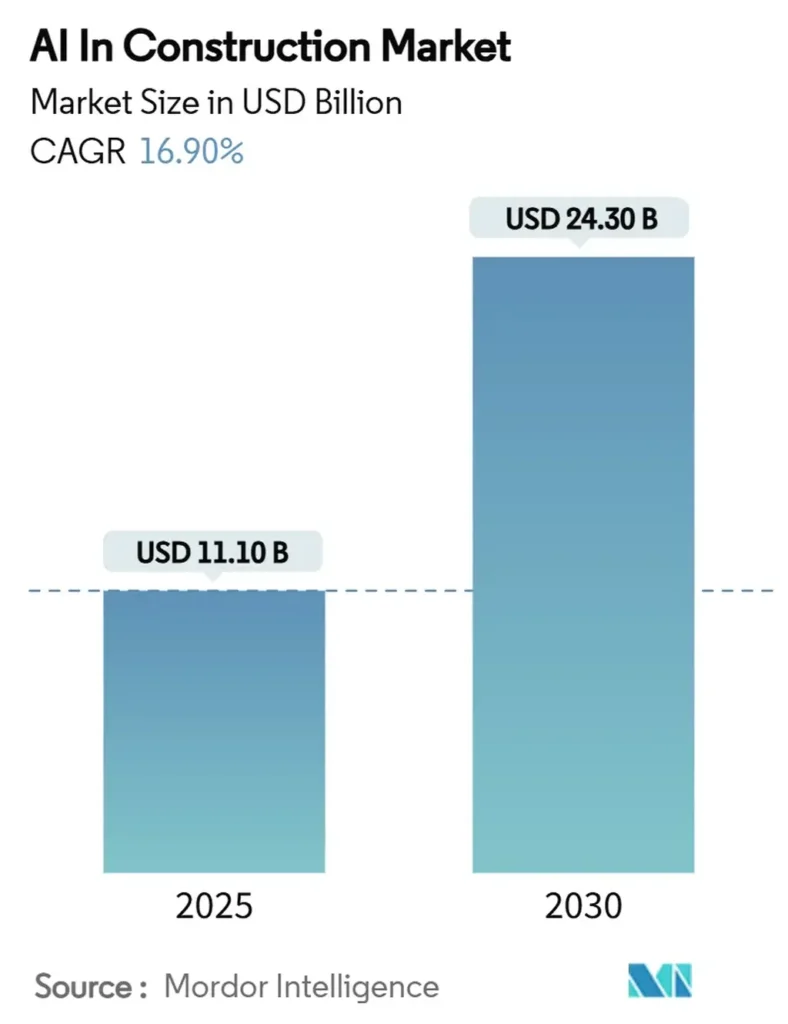
The construction industry is undergoing a seismic shift, with artificial intelligence (AI) emerging as a powerful catalyst for transformation. The global AI in construction market, valued at USD 600 million in 2022, is projected to skyrocket to USD 7,800 million by 2030, growing at a remarkable CAGR of 33.7 percent. This surge is not just about numbers; it’s about redefining how we build, manage, and sustain our urban landscapes.
AI is revolutionizing construction by enabling data-driven decision-making, predictive analytics, automated project planning, and enhanced safety monitoring. Technologies such as machine learning, computer vision, drones, robotics, and digital twins are being seamlessly integrated into construction operations. These innovations are not just improving efficiency; they are reducing costs, enhancing productivity, and ensuring safety compliance across workflows.
The market’s expansion is driven by the rising digitalization of construction processes, the increasing adoption of AI-enabled project management tools, and the growing need for real-time insights in large-scale infrastructure projects. AI is already being used for equipment monitoring, risk prevention, quality inspection, and progress tracking. This shift towards AI-driven construction is not just a trend; it’s a necessity, as the industry grapples with labor shortages, rising costs, and the urgent need for sustainable practices.
North America and Europe are leading the charge in AI adoption, thanks to strong investments in construction technology and a high demand for automation. However, the Asia-Pacific region is rapidly emerging as a fast-growing market, supported by rapid urbanization and large infrastructure development initiatives. This global momentum is evident in recent developments:
In the United States, AI-powered project management platforms are being deployed for real-time scheduling, resource allocation, and predictive risk analysis. American contractors are integrating AI-driven drone inspections and computer vision for site monitoring, safety compliance, and progress tracking. Meanwhile, U.S. builders are adopting AI-based predictive maintenance solutions to minimize downtime and optimize equipment utilization.
Globally, European construction firms are implementing AI-enabled Building Information Modeling (BIM) tools for automated clash detection, material optimization, and energy-efficient design. In the Asia-Pacific region, developers are using AI-powered safety analytics and wearable sensors to monitor worker health, detect hazards, and improve on-site accident prevention. Global construction software providers are launching generative AI platforms capable of automated blueprint design, structural analysis, and cost estimation for large-scale infrastructure projects.
The industry is also witnessing significant mergers and acquisitions. A leading U.S. construction software company acquired an AI-driven project analytics startup to expand predictive scheduling and safety-monitoring solutions. A European construction technology firm partnered with an Asian AI software company to co-develop generative AI tools for building design and smart construction automation. These strategic moves are reshaping the competitive landscape, with key players like Building System Planning, Inc., SAP SE, Autodesk, Inc., NVIDIA Corporation, IBM, Microsoft, Oracle, Dassault Systèmes SE, Aurora Computer Services Limited, and PTC Inc. leading the charge.
The drivers behind this AI revolution are clear: the rising adoption of AI technologies for project planning, design optimization, and construction site management; the increasing use of AI-powered predictive analytics to reduce construction delays, cost overruns, and resource wastage; and the growing implementation of AI-based safety monitoring and risk assessment solutions to prevent workplace accidents. The expansion of BIM integrated with AI for efficient project lifecycle management, the rising demand for autonomous construction equipment, drones, and robotics for on-site automation, and the growing focus on smart infrastructure and sustainable construction practices are all contributing to this transformative shift.
Industry developments are equally compelling. AI-driven construction management platforms are being launched for real-time monitoring, predictive maintenance, and productivity optimization. AI is being integrated with drones and IoT sensors for site surveillance, progress tracking, and quality control. Strategic partnerships are being formed between AI solution providers and construction firms to develop automated machinery and intelligent project planning tools. Machine learning models are being developed to predict equipment failures, cost variations, and project delays. Generative design AI tools are being adopted to optimize building structures, reduce material usage, and enhance sustainability. AI-based robotics are being used for concrete pouring, bricklaying, and autonomous machinery operations. Investments are being made in digital twins and AI simulation platforms for virtual construction testing and risk mitigation.
Regionally, North America leads with a 36% share, driven by the rapid adoption of AI-based construction management software, strong R&D investments, and widespread use of robotics and drones in building projects. Europe follows with a 28% share, supported by a growing emphasis on sustainable and smart infrastructure, stringent construction regulations, and increasing use of predictive analytics. The Asia-Pacific region is not far behind, with a 32% share fueled by rapid urbanization, expansion of