
In the face of escalating environmental concerns and a relentless push for sustainable infrastructure, the construction industry is witnessing a seismic shift. The geopolymer market, poised to grow from USD 10.255 billion in 2025 to USD 21.003 billion by 2030 at a CAGR of 15.42%, is at the heart of this transformation. These inorganic ceramic materials, with their exceptional heat and fire resistance, are carving out a significant niche in construction, particularly in developing economies where infrastructure demands are surging. Their applications span civil infrastructure, oil and gas, and chemical industries, offering critical support for repair and rehabilitation projects in bridges, tunnels, highways, pipes, and building structures.
The construction sector, a primary consumer of geopolymers, is increasingly turning to these materials to address the environmental pitfalls of traditional building materials. Conventional cement production and construction processes are notorious for their greenhouse gas emissions, making the demand for sustainable alternatives like geopolymers more urgent than ever. The market’s segmentation reveals a broad adoption pattern driven by the superior heat and fire resilience of geopolymers, positioning them as essential materials for industries requiring high-performance, environmentally conscious construction solutions.
Infrastructure construction and transportation investments are key drivers of this growth. In emerging nations, government investments in transportation infrastructure are creating expanding opportunities for geopolymer applications in road construction, bridge development, and transit system implementation. Geopolymers are particularly valuable as substitutes for Ordinary Portland Cement and lime in soil stabilization applications, addressing both performance requirements and environmental sustainability objectives in large-scale construction projects.
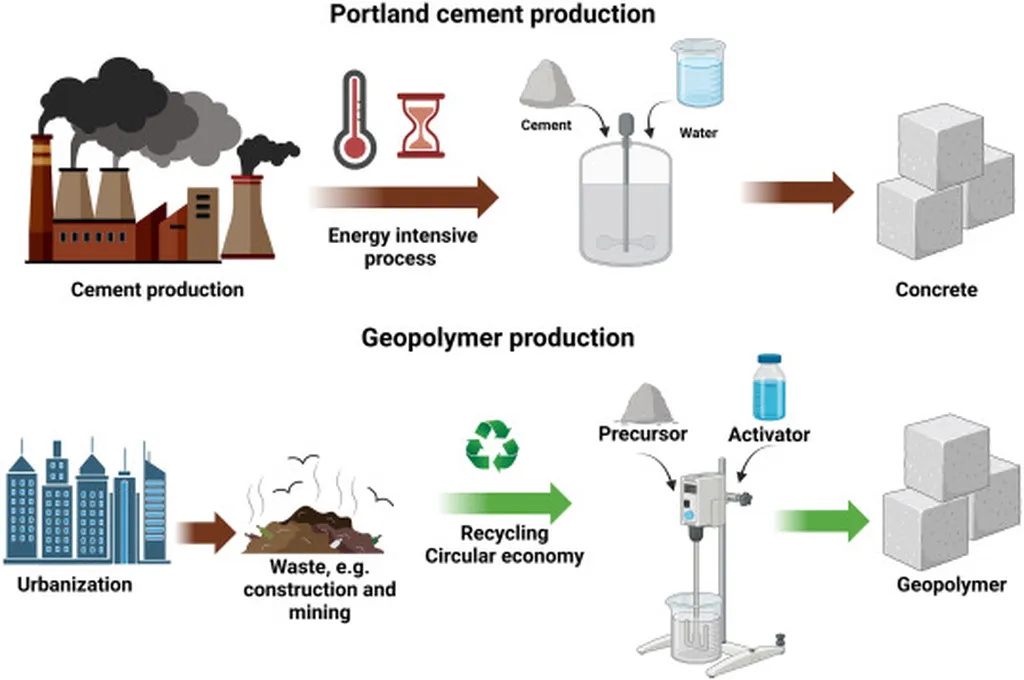
Environmental sustainability and waste utilization are also significant growth boosters. Geopolymer concrete provides alternatives to Portland-based concrete while incorporating waste materials from industrial mining and power plant operations. This approach creates cleaner environmental outcomes by encapsulating industrial byproducts that would otherwise require disposal and pose environmental risks. The technology enables carbon emission reductions while giving industrial waste materials productive applications in construction projects, addressing environmental concerns while providing cost-effective construction materials that meet performance requirements.
Geopolymers offer numerous technical advantages, including high resilience, low creep characteristics, acid resistance, ultra-porosity, and low drying contraction properties. These characteristics make geopolymers particularly suitable for demanding applications in oil and gas, civil infrastructure, and chemical industries where conventional materials may not provide adequate performance. The combination of superior technical properties with environmental benefits creates compelling value propositions for infrastructure projects requiring long-term durability and sustainability considerations.
The Asia Pacific region is leading this growth, driven by increased demand from end-user industries and substantial investment activities by major regional economies. Rising infrastructure investments create substantial market opportunities as governments prioritize transportation system development, airport expansion, and expressway network enhancement projects. These large-scale infrastructure initiatives require materials that combine performance capabilities with environmental sustainability, positioning geopolymers favorably for major construction projects.
Foreign direct investment flows into construction development and construction activities support market expansion by providing capital for infrastructure projects that utilize advanced materials including geopolymers. Infrastructure development receives significant portions of total foreign investment flows, creating financial support for projects implementing sustainable construction technologies.
Geopolymer applications extend beyond traditional construction into specialized industrial applications requiring exceptional material properties. The technology’s ability to handle extreme environmental conditions while providing structural integrity makes it valuable for infrastructure rehabilitation projects and new construction requiring superior performance characteristics. Industrial waste incorporation capabilities enable geopolymer production using byproducts from multiple industries, creating circular economy benefits while producing high-performance construction materials.
The geopolymer market operates within a dynamic environment characterized by growing environmental sustainability requirements, expanding infrastructure investment, and increasing recognition of superior material properties that address both performance and environmental objectives in construction and industrial applications. Key players in the market include Geopolymer Solutions LLC, CEMEX S.A.B. de C.V., Wagners, Schlumberger Limited, PCI Augsburg GmbH, Banah UK Ltd., Murray & Roberts Holdings Limited, Rocla Pty Limited, Ecocem Materials Limited, Alchemy Geopolymer Solutions, Zeobond Pty Ltd, and Milliken Infrastructure Solutions.
As the construction industry grapples with the urgent need for sustainable practices, geopolymers emerge as a promising solution. Their ability to reduce carbon emissions, utilize industrial waste, and provide superior performance in challenging environments positions them as a cornerstone of future construction projects. The industry’s shift towards geopolymers is not just a trend; it’s a necessary evolution in response to global environmental challenges and the growing demand for sustainable infrastructure.