
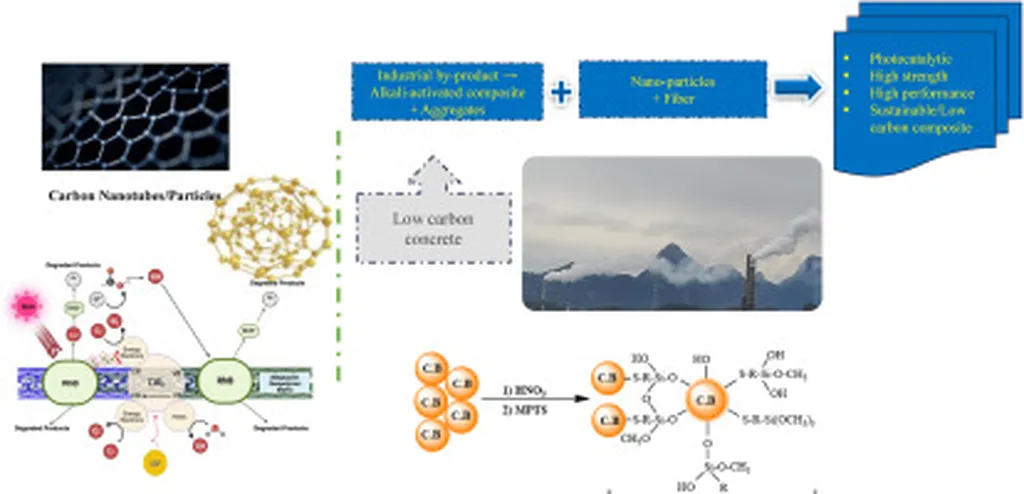
In the quest for sustainable construction materials, a groundbreaking review published in *Case Studies in Construction Materials* (translated as *Case Studies in Building Materials*) is making waves. Led by J. Vignesh from the Department of Civil Engineering at Saveetha School of Engineering in Chennai, India, the research delves into the world of nano-doped engineered geopolymer composites, offering a glimpse into the future of low-carbon construction.
Geopolymers, often hailed as a promising alternative to traditional Portland cement, have long been touted for their eco-friendly credentials. However, their inherent brittleness has posed a significant challenge, limiting their widespread adoption in structural applications. Enter nano-doped engineered geopolymer composites, a innovative solution that combines fiber reinforcement with nanomaterials to enhance toughness and mechanical properties.
The review, which synthesizes research from 2010 to 2025, explores the synergy between fiber and nanomaterial reinforcement, improvements in processing methods, and the intricate relationship between structure and properties. Key nanomaterials like nano-silica, carbon nanotubes, and nano-clays take center stage, each playing a pivotal role in modifying the chemical properties of the matrix, enhancing fiber-matrix bonding, and influencing crack propagation.
“Nanomaterials act as tiny architects, reshaping the microstructure of geopolymers at the nanoscale,” explains Vignesh. “This not only improves mechanical performance but also opens up new avenues for creating multifunctional composites with self-sensing capabilities.”
The study also scrutinizes various processing methods, from conventional casting to additive manufacturing, and their impact on composite performance. Mechanical behavior, impact resistance, fatigue performance, and durability under chemical, thermal, and environmental exposures are rigorously evaluated, providing a comprehensive overview of the current state and future potential of these advanced materials.
The commercial implications for the energy sector are substantial. As the world shifts towards sustainable infrastructure, the demand for low-carbon, high-performance construction materials is set to soar. Nano-engineered geopolymer composites could play a pivotal role in this transition, offering a durable, eco-friendly alternative to traditional materials.
However, challenges remain. The review highlights issues related to nanomaterial dispersion, scalability, standardization, cost, and environmental concerns. Addressing these hurdles will be crucial in unlocking the full potential of these innovative materials.
As the construction industry stands on the cusp of a technological revolution, Vignesh’s research offers a roadmap for the future. By harnessing the power of nanomaterials and advanced processing techniques, the dream of sustainable, resilient infrastructure may soon become a reality.
In the words of Vignesh, “The future of construction lies in the intersection of innovation and sustainability. Nano-engineered geopolymer composites represent a significant step forward in this journey, offering a glimpse into the possibilities that lie ahead.”