
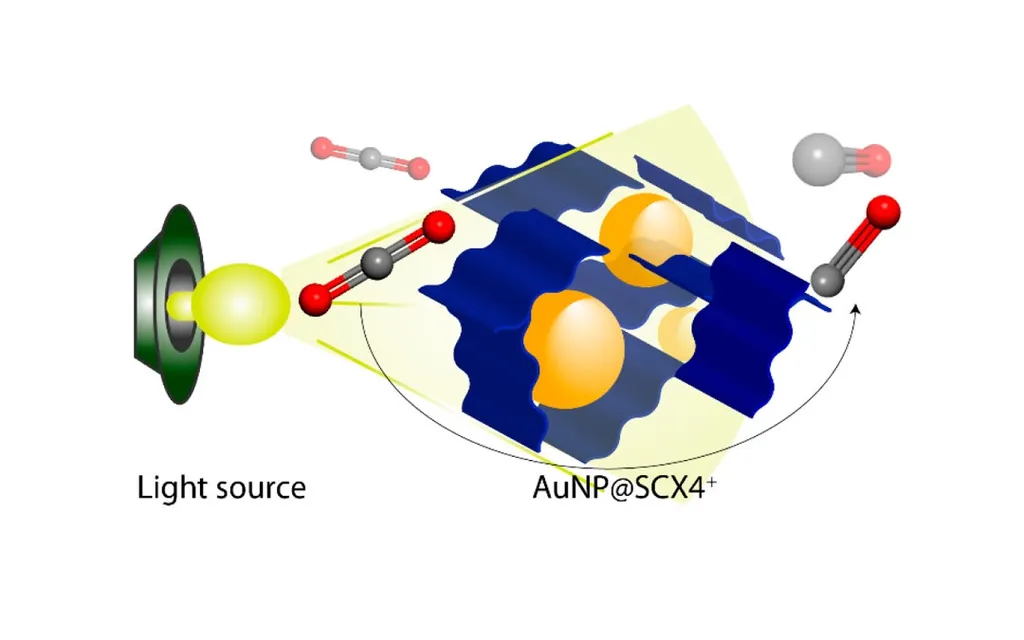
In a significant stride towards sustainable energy solutions, researchers have developed a novel photocatalyst that could revolutionize the conversion of carbon dioxide (CO₂) into renewable fuels. This breakthrough, published in the Journal of CO2 Utilization (translated as “Journal of Carbon Dioxide Utilization”), offers promising implications for the energy sector, particularly in the realm of carbon-neutral technologies.
At the heart of this research is a meticulously engineered trimetallic CoAlLa layered double hydroxide (CoAlLa-LDH), integrated with multilayered Ti₃C₂ MXene and TiO₂ nanoparticles. The lead author, Azmat Ali Khan from the Chemical and Petroleum Engineering Department at the United Arab Emirates University, explains, “We aimed to enhance CO₂ photoreduction by creating a distinctive S-scheme heterojunction. This involves a strong interaction between a p-type CoAlLa-LDH and an n-type TiO₂, which effectively promotes charge separation and reduces electron-hole recombination.”
The results are impressive. The photocatalytic conversion of CO₂ with H₂O using this nanocomposite produced 38.25 µmol of CO and 3.36 µmol of CH₄ in just 4 hours. Compared to traditional TiO₂ and LDH materials, the performance improvement is substantial, with increases of 3.6 and 4.3 times for CO production and 2.64 and 3.28 times for CH₄ production, respectively.
The enhanced performance is attributed to the construction of a heterostructure that offers abundant active sites and a strong connection between nanomaterials. This fosters the generation of an electric field and accelerates the transport of generated charge carriers. Stability tests further confirmed the high stability of the CoAlLa-LDH/Ti₃C₂/TiO₂ nanocomposite over multiple cycles, demonstrating its long-term viability as a photocatalyst.
This research not only provides a new pathway for designing highly efficient photocatalysts but also offers insightful guidance for future advancements in sustainable energy conversion. As Khan notes, “Our work endorses the generation of an electric field and hastens the transport of generated charge carriers, which is crucial for the development of carbon-neutral technologies.”
The commercial impacts of this research are profound. By converting CO₂ into renewable fuels, this technology could significantly reduce greenhouse gas emissions and contribute to the global shift towards sustainable energy. The energy sector stands to benefit immensely from this innovation, as it opens new avenues for clean energy production and carbon management.
In conclusion, this research represents a significant step forward in the field of photocatalysis and CO₂ reduction. The development of the CoAlLa-LDH/Ti₃C₂/TiO₂ nanocomposite offers a promising solution for sustainable energy conversion, with far-reaching implications for the energy sector and beyond. As the world continues to grapple with the challenges of climate change, such innovations are crucial in paving the way for a more sustainable future.