
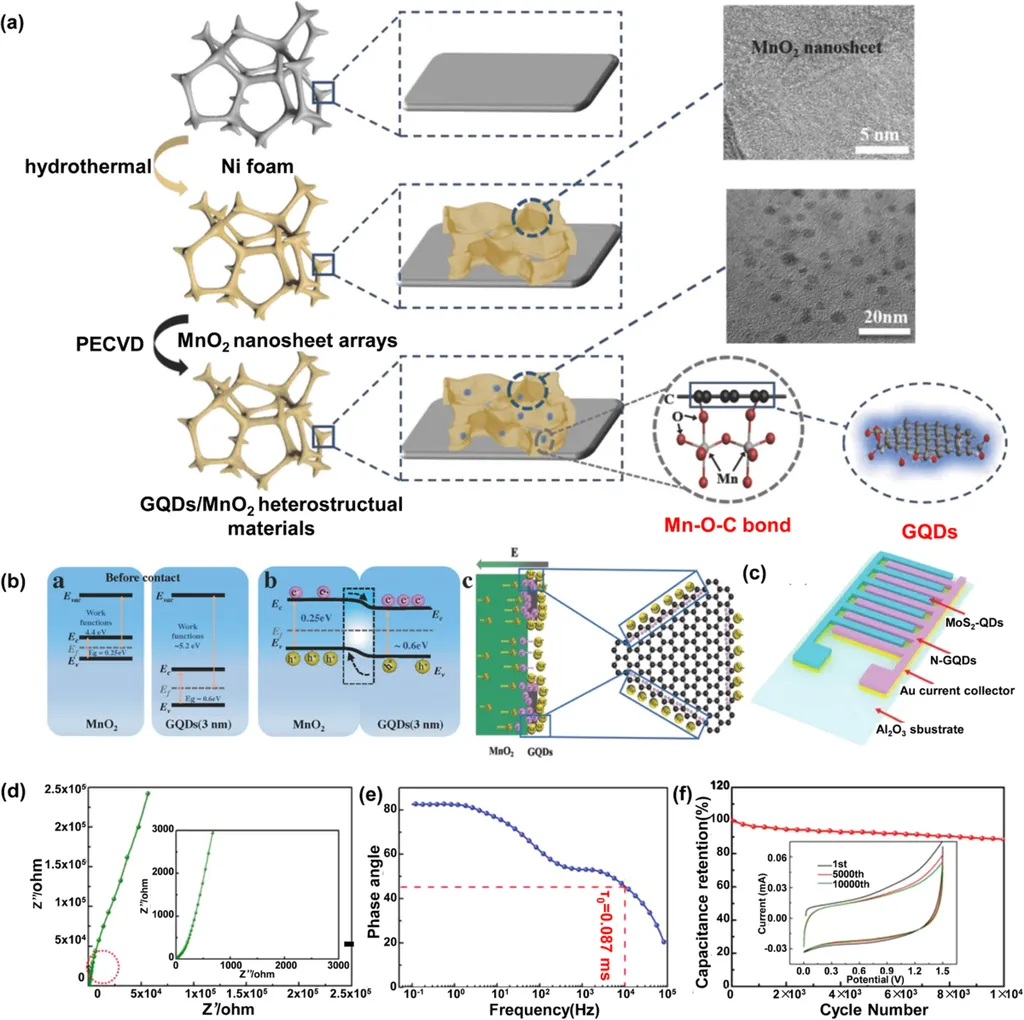
In the heart of China, researchers at Central South University in Changsha are making waves in the energy sector with their groundbreaking work on graphene quantum dots (GQDs). These tiny fragments of graphene, typically ranging from 1 to 10 nanometers in size, are opening up new possibilities for energy storage devices, according to a recent study published in the *International Journal of Extreme Manufacturing* (translated as *International Journal of Extreme Manufacturing*). The lead author, Zhenglei Geng, and his team are exploring how these minuscule particles can revolutionize the way we store and use energy.
Graphene quantum dots are synthesized under extreme conditions, such as oxidative/reductive cleavage, electrochemical shearing, and pulsed laser burning. Their extremely small size and edge effects give them a high specific surface area, abundant surface active sites, chemical stability, low toxicity, physiological stability, and tunable fluorescence properties. These unique characteristics make GQDs highly versatile, with applications ranging from energy and catalysis to environmental, biological, and optical fields.
The research team is particularly interested in the potential of GQDs to enhance the performance of energy storage systems (ESSs). “We are at an early stage of understanding how GQDs can be applied in energy storage,” says Geng. “But the progress we’ve made so far is promising. We’ve seen improvements in ion diffusion kinetics, suppression of dendrite formation, and stabilization of electrode-electrolyte interfaces in lithium, sodium, and zinc-ion batteries.”
The implications for the energy sector are significant. As the world shifts towards renewable energy sources, the need for efficient and reliable energy storage solutions becomes increasingly critical. GQDs could play a pivotal role in this transition, offering a way to store energy more effectively and enhance the overall performance of energy storage devices.
The team’s research also extends to solar cells and supercapacitors. By tuning light absorption and optimizing charge transport, GQDs can boost solar cell efficiency. Similarly, their high surface area and pseudocapacitive contributions can elevate the energy density of supercapacitors.
As the world grapples with the challenges of climate change and the need for sustainable energy solutions, the work of Geng and his team offers a glimmer of hope. Their research suggests that graphene quantum dots could be a game-changer in the energy sector, paving the way for more efficient and reliable energy storage devices.
The study, published in the *International Journal of Extreme Manufacturing*, provides a timely and up-to-date overview of the latest advancements in GQD technology and its applications in energy storage. As the world continues to seek innovative solutions to its energy challenges, the work of Geng and his team is a testament to the power of scientific research and its potential to shape a more sustainable future.
In the words of Geng, “The future challenges are significant, but so are the opportunities. We are excited about the potential of GQDs and look forward to seeing how this technology evolves in the coming years.”