
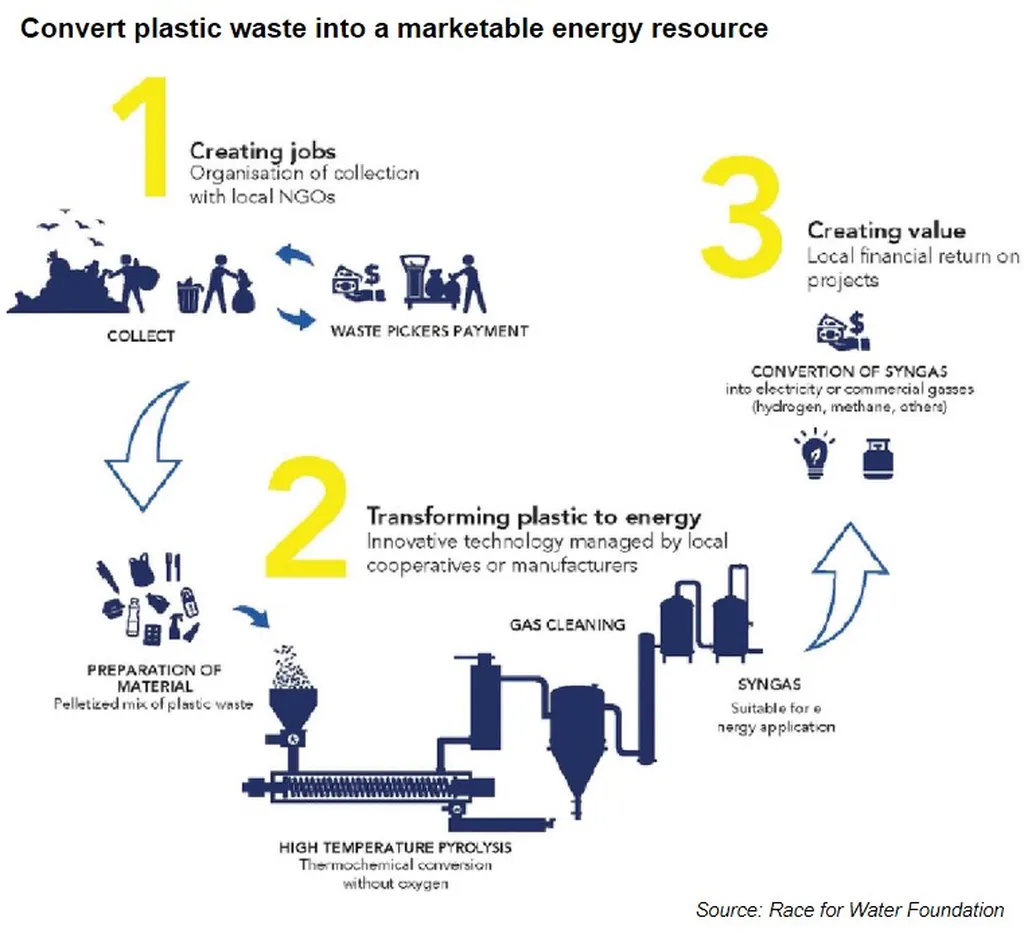
In a world drowning in plastic waste, a beacon of hope emerges from the Department of Pure and Applied Chemistry at Veritas University in Abuja, Nigeria. Dr. Godwin A. Udourioh and his team have published a comprehensive review in the journal *Hybrid Advances* (which translates to *Integrated Advances*), shedding light on cutting-edge technologies that could transform plastic waste into valuable resources. This isn’t just about recycling; it’s about revolutionizing how we perceive and utilize plastic waste, with significant implications for the energy sector.
Plastic waste is a global scourge, with over 4.9 trillion kg generated annually, yet only a paltry 9% recycled. Dr. Udourioh’s review explores advanced valorization techniques—chemical, thermal, and biological—that could turn this tide. “We’re not just talking about breaking down plastic,” Udourioh explains. “We’re talking about converting it into high-value monomers, liquid fuels, 3D-printing filaments, and even sustainable construction materials.”
The review delves into recent breakthroughs in advanced depolymerization, biocatalytic degradation, and hybrid catalytic systems. These technologies are assessed for their efficiency, selectivity, and readiness for large-scale implementation. One of the most compelling aspects of this research is its focus on economic viability and energy consumption. “We need technologies that are not only effective but also economically viable and energy-efficient,” Udourioh emphasizes. “This is crucial for their adoption and integration into existing industrial processes.”
The energy sector stands to gain significantly from these advancements. Converting plastic waste into liquid fuels, for instance, could provide a sustainable and renewable energy source. Moreover, the conversion of plastic into high-value monomers could reduce the dependency on fossil fuels for producing new plastics, creating a more circular economy.
The review also highlights the importance of policy frameworks in facilitating the large-scale deployment of these technologies. “Policy plays a pivotal role in driving innovation and adoption,” Udourioh notes. “We need supportive policies that encourage investment in these technologies and provide incentives for their implementation.”
Dr. Udourioh’s research proposes a strategy for integrating valorization technology into circular economy models. By incorporating lifecycle assessment metrics, the team aims to maximize environmental advantages and overcome adoption barriers. This roadmap underscores key research goals that could shape the future of plastic waste management.
The implications of this research are far-reaching. As the world grapples with the challenges of plastic waste, technologies that can convert this waste into valuable resources offer a glimmer of hope. They promise a future where plastic waste is not a burden but a resource, contributing to a more sustainable and circular economy.
In the words of Dr. Udourioh, “This is not just about managing waste; it’s about creating value from waste. It’s about turning a global problem into a global opportunity.” With the insights and strategies outlined in this review, the path to achieving this vision becomes clearer and more attainable.