
In the ever-evolving world of construction and infrastructure, researchers are constantly seeking innovative solutions to age-old problems. One such challenge is the stabilisation of marl soil, a complex and variable material that has long posed difficulties for engineers. Enter Lacheheub Loubna Kamar, a researcher from the Laboratory of Civil Engineering and Hydraulics at University 8 Mai 1945 in Guelma, Algeria. Her recent study, published in the journal ‘Civil and Environmental Engineering’ (translated from French as ‘Génie Civil et Environnemental’), offers a promising new approach to this persistent issue.
Marl soil, with its intricate mechanical behavior, has traditionally been a headache for construction projects. “Marls’ complex and variable mechanical behavior makes them difficult to use as backfill materials,” Kamar explains. The conventional methods of chemical soil stabilisation, while effective, often fall short when dealing with highly plastic soils or those subjected to frequent drying and wetting cycles. Moreover, traditional agents like cement and lime come with their own set of drawbacks, including high costs and environmental impacts.
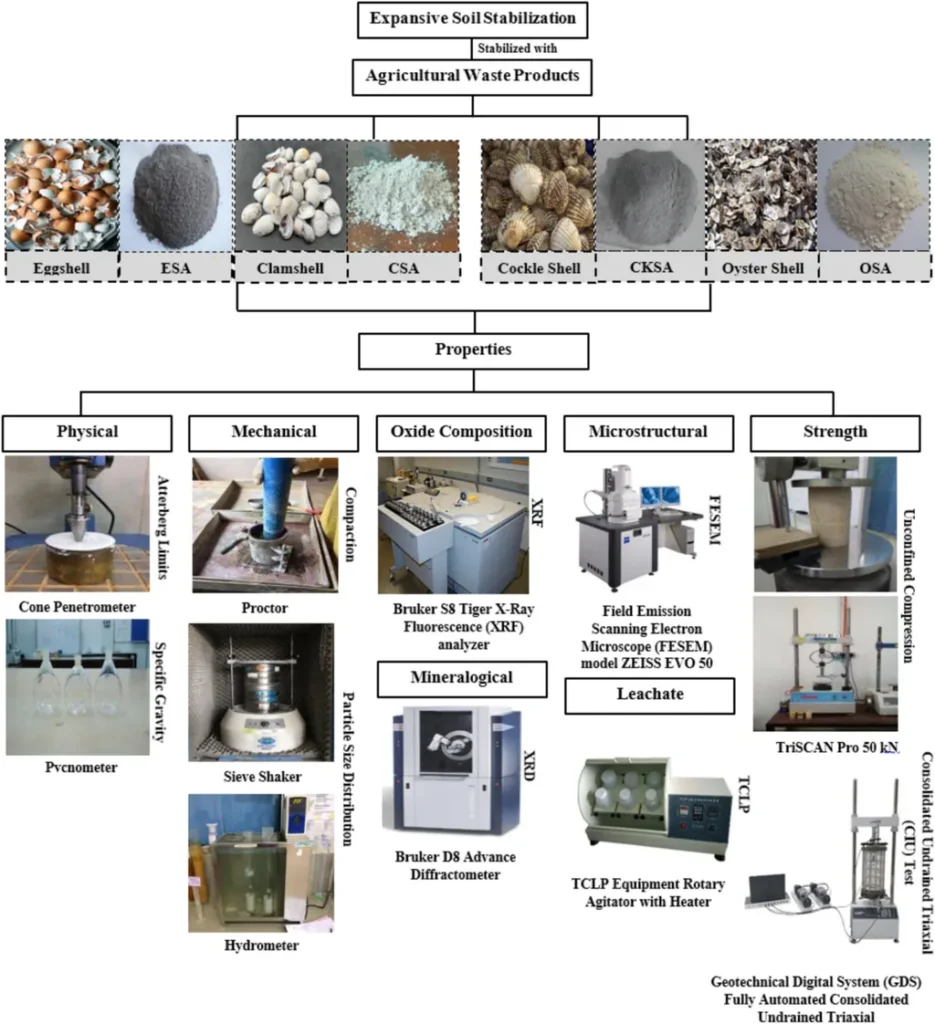
Kamar’s research introduces an unconventional binder made from recycled eggshell quicklime and natural zeolite. This innovative mixture aims to improve the mechanical properties of marl soil, offering a more sustainable and environmentally friendly solution. The study involved a series of tests, including unconfined compression, Californian Bearing Ratio, and rectilinear shear tests, conducted on samples treated with varying dosages of the binder and different curing times.
The results were promising. The compressive strength ratios of the treated soil increased by 4 to 11 times, the Immediate Bearing Index (IBI) exceeded 20, and the friction angle (φ) increased up to 25°. “The addition of zeolite to eggshell quicklime for soil stabilisation appears to have a positive effect on the different parameters studied,” Kamar notes. This finding suggests that the admixture of these two materials could represent a significant advancement in the field of soil stabilisation.
The implications of this research are far-reaching, particularly for the energy sector. Stable and reliable soil is crucial for the construction of infrastructure such as pipelines, power plants, and renewable energy installations. The use of recycled materials like eggshell quicklime not only reduces environmental impact but also offers a cost-effective solution. As the world moves towards more sustainable practices, innovations like Kamar’s could play a pivotal role in shaping the future of construction and infrastructure development.
This study opens up new avenues for research and application in soil stabilisation. The use of unconventional binders like eggshell quicklime and zeolite could revolutionise the way engineers approach soil treatment, offering a more sustainable and efficient alternative to traditional methods. As Kamar’s research demonstrates, the future of construction lies in innovation and sustainability, and this study is a significant step in that direction.
In the words of Kamar, “The admixture of these two materials represents a promising alternative for stabilising clayey marls, providing a more sustainable and environmentally friendly solution for earthworks.” This research not only advances our understanding of soil stabilisation but also paves the way for more sustainable and cost-effective construction practices in the energy sector and beyond.