
In the heart of China’s burgeoning electric vehicle (EV) industry, a groundbreaking study is set to redefine how cities plan for the future of EV charging infrastructure. Led by Hong Yuan of Chongqing University’s School of Management Science and Real Estate, the research published in the journal *Advances in Applied Energy* (translated as *Progress in Applied Energy*) offers a novel, demand-driven approach to optimizing city-scale capacity allocation for EV charging.
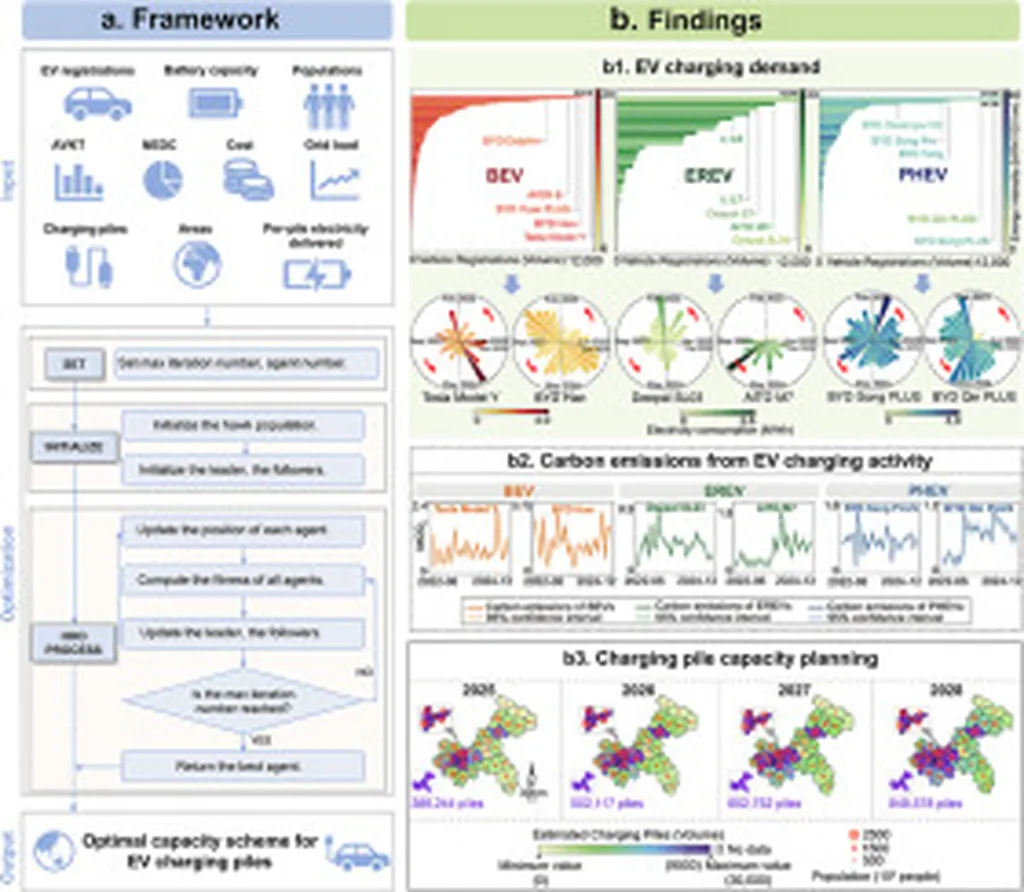
The study, which focuses on Chongqing—a city with a robust industrial base and supportive policies for EVs—provides a multi-objective planning model that could revolutionize how urban areas prepare for the low-carbon transition. “Our model employs a bottom-up approach to estimate charging demand, differentiating between battery electric vehicles (BEVs), extended-range electric vehicles (EREVs), and plug-in hybrid electric vehicles (PHEVs),” Yuan explains. This granular approach allows for more precise and efficient planning, ensuring that charging infrastructure meets real-world demand.
Between 2022 and 2024, Chongqing saw a significant rise in EV electricity consumption, from 18.9 gigawatt-hours (GWh) to 57.5 GWh, with associated carbon emissions increasing from 9.9 kilotons of carbon dioxide (ktCO2) to 30 ktCO2. The city also installed 181,622 additional charging piles during this period, with the fastest growth observed in Yubei district. This growth reflects a strategic, demand-responsive approach that prioritizes areas with higher population density, higher income levels, and adequate land availability for pile deployment.
Looking ahead, the study projects that EV electricity demand in Chongqing will reach 1940 GWh by 2030, with the number of charging piles exceeding 1.4 million. Notably, charging demand from EREVs and PHEVs is expected to overtake that of BEVs later in the period. These projections highlight the need for flexible and adaptive planning models that can accommodate evolving demand patterns.
The implications for the energy sector are profound. As cities worldwide grapple with the challenges of low-carbon electrification, Yuan’s model offers a versatile tool for policymakers and energy providers. “Our planning platform is adaptable for application in cities around the world, enabling cross-regional comparisons under diverse socio-economic, geographic, and policy conditions,” Yuan notes. This adaptability is crucial for ensuring that EV infrastructure deployment is both sustainable and cost-effective.
The research not only provides a roadmap for Chongqing but also sets a precedent for other cities aiming to balance economic growth with environmental sustainability. By offering a data-driven, demand-responsive approach, the study could shape future developments in EV infrastructure planning, ensuring that cities are well-prepared for the transition to electric mobility. As the world continues to shift towards low-carbon energy systems, Yuan’s work stands as a beacon of innovation and practicality, guiding the way forward for the energy sector.