
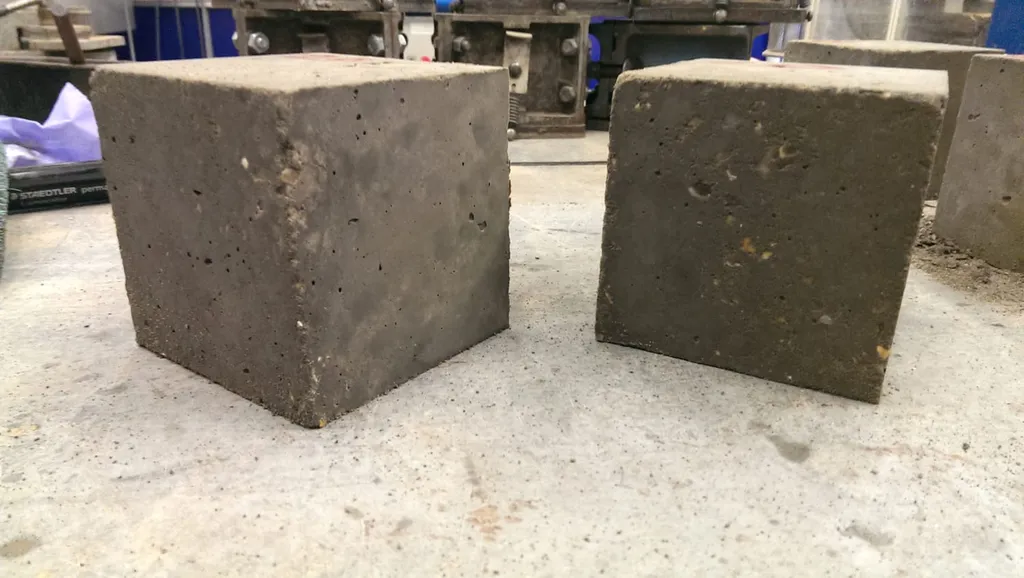
In the quest for sustainable construction materials, researchers are turning to the nanoscale to revolutionize concrete. A recent study published in the *BIO Web of Conferences* (or *Conference Proceedings on Biology and Life Sciences* in English) explores how nanoengineered green concrete could bridge material science and environmental performance, offering significant benefits for the energy sector and beyond.
Nurrizky Amanda, a researcher from the Department of Civil Engineering at Universitas Muhammadiyah Yogyakarta, led the study, which delves into the potential of Supplementary Cementitious Materials (SCMs) and nanomaterials to enhance concrete’s mechanical strength, durability, and environmental performance. “By integrating SCMs like fly ash and silica fume with nanomaterials such as nano-silica or carbon nanotubes, we can create a concrete that is not only stronger but also more sustainable,” Amanda explains.
The construction industry is a significant contributor to global CO₂ emissions, with traditional concrete production accounting for a substantial portion. The shift towards green concrete is not just an environmental imperative but also a commercial opportunity. “These innovations reduce CO₂ emissions and enable the reuse of industrial by-products, contributing to a more circular economy,” Amanda notes. This circular approach could lead to cost savings and new revenue streams for companies that repurpose waste materials.
The study also highlights the role of molecular dynamics (MD) simulations in understanding the micro- and nanoscale behavior of cementitious materials. These simulations provide insights into key factors such as ion transport, thermal conductivity, and mechanical performance, which are crucial for developing high-performance, eco-friendly concrete.
The implications for the energy sector are profound. Green concrete could be used in the construction of energy-efficient buildings, reducing the overall energy consumption of structures. Additionally, the enhanced durability and strength of nanoengineered concrete could extend the lifespan of energy infrastructure, from wind turbines to power plants, reducing maintenance costs and improving reliability.
However, the path to widespread adoption is not without challenges. “Continued research is needed to address scalability, cost, and long-term durability in practical applications,” Amanda emphasizes. The study underscores the need for ongoing innovation and collaboration between academia and industry to overcome these hurdles.
As the construction industry grapples with the demands of sustainability and performance, nanoengineered green concrete offers a promising solution. By harnessing the power of nanotechnology and computational modeling, researchers like Nurrizky Amanda are paving the way for a future where high-performance materials and environmental responsibility go hand in hand. The study, published in the *BIO Web of Conferences*, serves as a call to action for the industry to embrace these innovations and drive the transition towards a more sustainable built environment.