
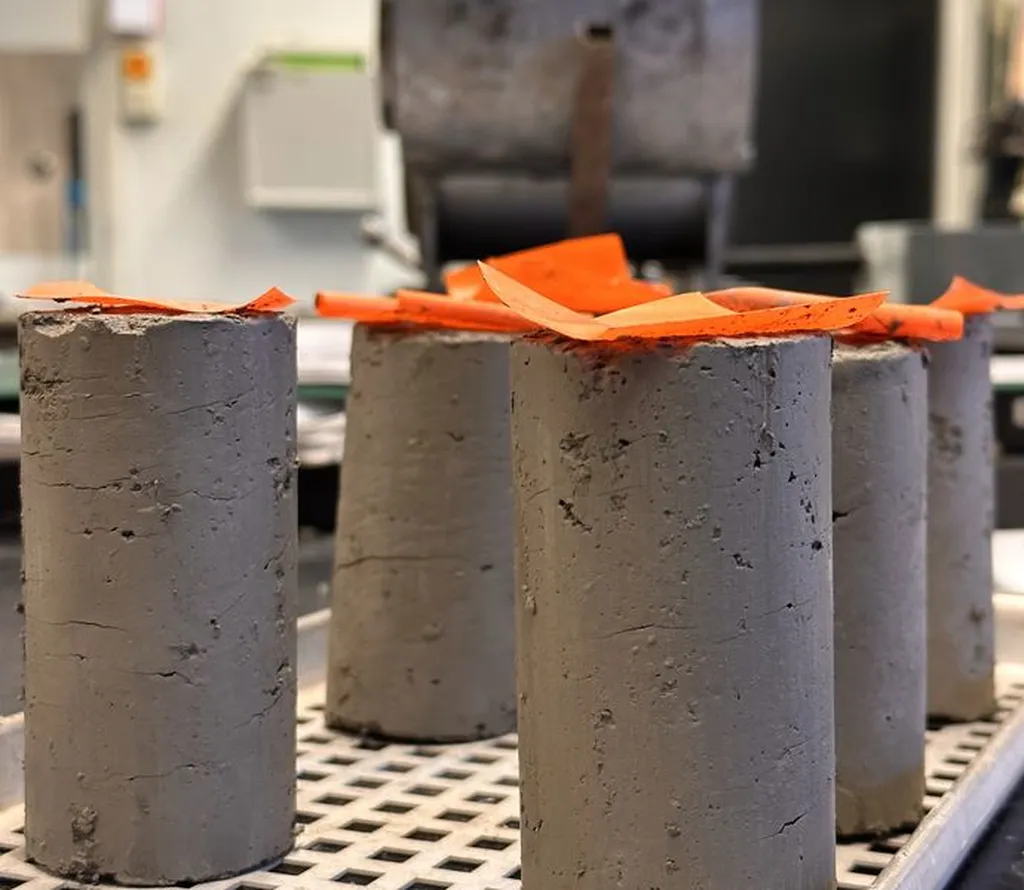
In the quest for sustainable construction materials, researchers have made a significant stride by transforming recycled concrete fines (RCF) into reactive binders, potentially revolutionizing the industry’s approach to waste and carbon emissions. A recent study led by Yutong Ju from the School of Civil and Environmental Engineering at Harbin Institute of Technology, Shenzhen, explores the thermal activation of RCF containing residual sand particles, offering a promising solution for a more circular economy in construction.
The challenge with recycled concrete fines has always been the embedded sand particles, which hinder phase development during thermal activation. Ju and her team tackled this issue by adjusting the calcium-to-silicon ratio through the addition of limestone, producing reactivated cementitious materials (RCM). “By fine-tuning the calcium content and activation temperature, we can significantly enhance the reactivity of the sand particles and promote the formation of beneficial mineral phases,” Ju explained.
The study, published in the journal *Carbon Capture Science & Technology* (translated from Chinese as 碳捕获科学与技术), revealed that higher activation temperatures combined with calcium addition improved the reactivity of the sand and the formation of minerals. Below 1000 °C, the team observed the development of α′H-C2S and β-C2S phases, while at 1200 °C, the phases transitioned to low-reactivity CS or C3S2. The optimal mechanical performance was achieved with RCMs activated at 1000 °C and 20 wt.% limestone addition, thanks to enhanced phase reactivity, carbonation efficiency, and pore refinement.
The implications for the construction and energy sectors are substantial. The life cycle assessment conducted as part of the study showed a remarkable 61% reduction in CO2 emissions compared to traditional Portland cement. This finding underscores the potential of thermochemical tuning for closed-loop recycling of RCF, aligning with global efforts to reduce carbon footprints and promote sustainable practices.
As the construction industry grapples with the dual challenges of waste management and carbon reduction, this research offers a beacon of hope. By valorizing recycled concrete fines into reactive binders, the industry can significantly cut down on waste and emissions, contributing to a more sustainable future. “Our findings demonstrate the viability of using thermally activated RCF as a sustainable alternative to conventional binders,” Ju noted. “This approach not only reduces the environmental impact but also opens up new avenues for commercial applications in the construction and energy sectors.”
The study’s insights could pave the way for future developments in the field, encouraging further research and innovation in the area of recycled construction materials. As the world moves towards a more circular economy, the ability to transform waste into valuable resources becomes increasingly crucial. This research is a testament to the power of scientific inquiry and its potential to drive positive change in the industry.