
In a groundbreaking study published in the journal *Materials & Design* (translated from Spanish as *Materials & Design*), researchers have unveiled a deeper understanding of the optical properties of key cementitious oxides, potentially paving the way for innovative energy-efficient building materials. The research, led by Jozef Janovec of the Centro de Física de Materiales-CFM (MPC) in San Sebastián, Spain, and the University of the Basque Country, explores how the interaction of light with cement oxides can be harnessed for advanced construction applications.
The study focuses on the optical properties of calcium oxide (CaO), silicon dioxide (SiO2), aluminum oxide (Al2O3), and iron oxide (Fe2O3), which are fundamental components of cement. Using sophisticated computational methods, including density functional theory (DFT) and the Bethe–Salpeter equation (BSE), the researchers have demonstrated that the optical response of these materials is significantly influenced by the formation of strongly bound excitons—electron-hole pairs that interact strongly with light.
“This research shows that advanced computational methods beyond standard DFT are essential for accurately predicting the optical response of cementitious materials,” said Jozef Janovec, lead author of the study. “Our findings provide a framework for understanding light–matter interactions in cement oxides and establish a computational foundation for designing concrete-based composites with tailored optical and radiative properties.”
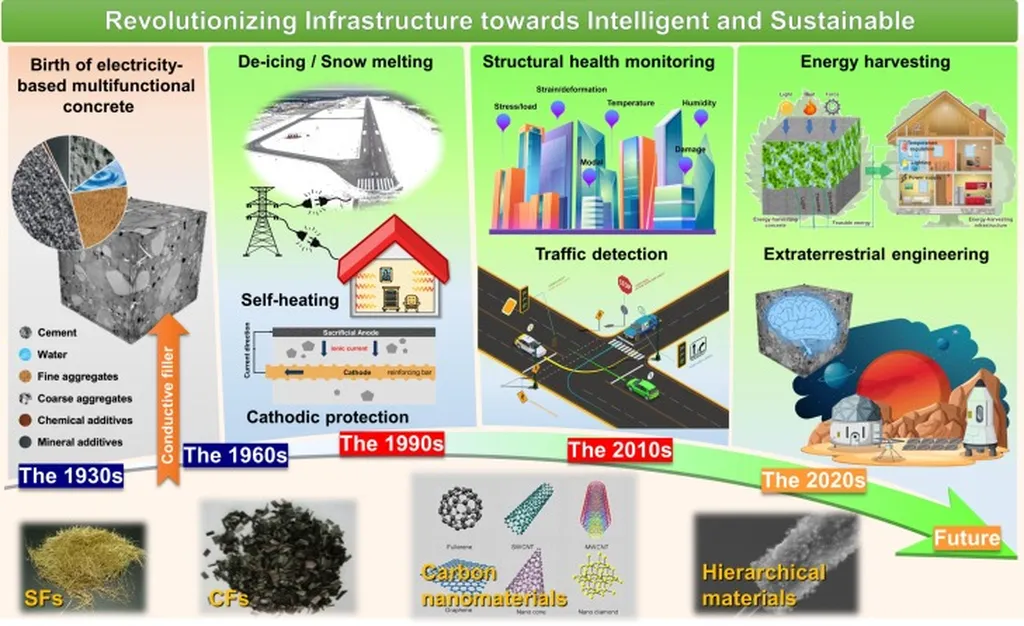
The implications of this research are far-reaching, particularly for the energy sector. By understanding and manipulating the optical properties of cementitious materials, engineers and architects can develop advanced construction materials that manage energy more efficiently. For instance, these materials could be used in passive energy management applications such as radiative cooling, which helps buildings stay cool without consuming additional energy.
“Our results demonstrate that the optical onset in the cement oxides is significantly influenced by the formation of strongly bound excitons,” Janovec explained. “This insight is crucial for designing materials that can interact with light in ways that enhance energy efficiency.”
The study’s findings could lead to the development of new concrete-based composites that not only improve the structural integrity of buildings but also contribute to their energy performance. This aligns with the growing demand for sustainable and energy-efficient building technologies, which are critical in the fight against climate change.
As the construction industry continues to seek innovative solutions to reduce energy consumption and enhance sustainability, the insights provided by this research offer a promising path forward. By leveraging the optical properties of cementitious materials, the industry can create buildings that are not only durable and safe but also environmentally friendly and energy-efficient.
“This research is a significant step towards understanding the fundamental properties of cementitious materials and their potential applications in advanced construction technologies,” Janovec concluded. “It opens up new possibilities for designing materials that can contribute to a more sustainable future.”
With the publication of this study in *Materials & Design*, the scientific community now has a robust framework for exploring the optical properties of cement oxides, potentially revolutionizing the way we think about building materials and their role in energy management. As the world continues to grapple with the challenges of climate change and energy efficiency, this research offers a beacon of hope for a more sustainable and innovative future.