
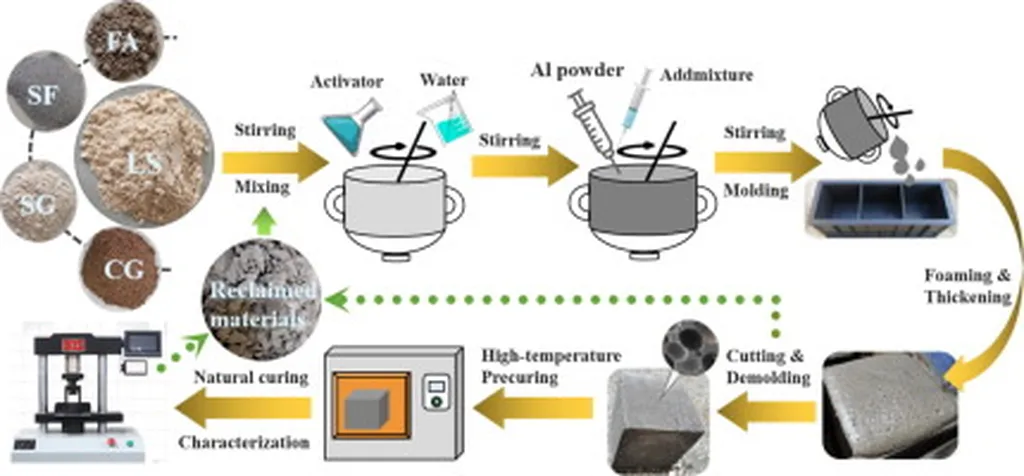
In a significant stride towards sustainable construction, researchers have developed foamed geopolymer materials that not only provide excellent thermal insulation but also possess the ability to adsorb carbon dioxide. This dual-functionality could revolutionize the building materials industry, offering a greener alternative that supports decarbonisation efforts. The research, led by Agnieszka Przybek, was recently published in *Technical Transactions*, which translates to *Technical Transactions* in English.
The study focuses on foamed geopolymers created from fly ash, a byproduct of coal combustion, using hydrogen peroxide as a foaming agent. Two variations of the foaming agent were tested to understand its impact on porosity, thermal insulation, and CO2 adsorption capacity. The results were promising, with the materials exhibiting low thermal conductivity, making them suitable as ecological building insulators.
Przybek explained, “The porous structure of these materials allows them to physically adsorb carbon dioxide, a capability that was influenced by the amount of foaming agent used.” Surprisingly, the research found that a smaller amount of the foaming agent could enhance CO2 adsorption capacity without compromising the insulation properties.
The thermal conductivity coefficient of these materials was measured to be as low as 0.101 W/m·K, confirming their potential as effective insulators. The sorption tests further revealed that the porosity parameters, dictated by the foaming agent quantity, played a crucial role in the efficiency of CO2 adsorption.
This innovative research suggests that foamed geopolymers could serve a dual purpose in the future: as insulation materials and passive CO2 adsorbents. “This could significantly support efforts towards sustainable development and decarbonisation in the construction sector,” Przybek noted.
The findings open up new avenues for the energy sector, particularly in the development of eco-friendly building materials that contribute to reducing carbon emissions. As the world grapples with the challenges of climate change, such advancements in material science are not just welcome but necessary.
The research published in *Technical Transactions* provides a foundation for further in-depth analyses into the potential of foamed geopolymers as carbon dioxide-absorbing materials. It is a stepping stone towards a future where buildings are not just structures but active participants in the fight against climate change.
As the construction industry continues to evolve, the integration of such dual-function materials could redefine the standards of sustainable building practices. The work of Przybek and her team is a testament to the power of innovative research in driving the energy sector towards a greener and more sustainable future.