
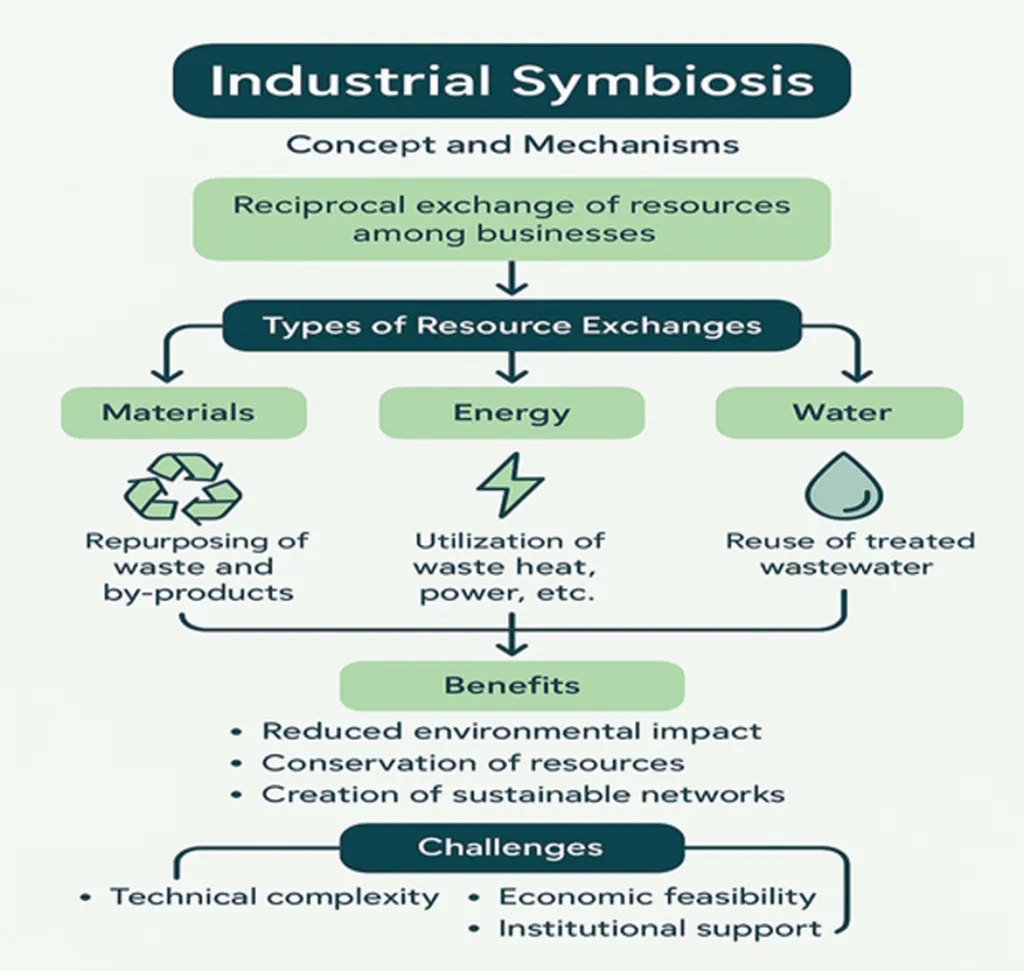
In a significant stride towards sustainability, researchers have developed an automated framework to construct a comprehensive database that could revolutionize industrial symbiosis, offering substantial benefits to the energy sector and beyond. The study, led by Lan Zhao from the School of Electrical and Electronic Engineering at Nanyang Technological University, introduces a novel approach to identifying waste-to-resource opportunities, published in the journal *Nature Communications* (which translates to “Nature Communications” in English).
Industrial symbiosis, a concept that encourages collaboration between industries to exchange waste-to-resource, has long been recognized as a key strategy in achieving circular economy goals. However, the manual construction of databases that facilitate such exchanges has been a limiting factor, restricting the scalability and coverage of these valuable resources.
Zhao and her team have tackled this challenge head-on, proposing a framework that leverages large language models to transform unstructured text from research papers into a well-organized knowledge graph. This Waste-to-Resource Knowledge Graph (W2RKG) enhances the coverage, scalability, and standardization of the database, ultimately supporting industrial symbiosis practitioners in identifying new opportunities.
The framework comprises three main modules: a Retrieving Module, an Extraction Module, and a Fusion Module. These modules work together to extract and organize information from unstructured text, creating a structured database that contains 3,518 waste entities, 4,471 resource entities, and 33,679 waste-to-resource relationships.
“The potential of this framework is immense,” says Zhao. “It not only automates the construction of waste-to-resource databases but also ensures the quality and comprehensiveness of the data. This can significantly enhance the identification of industrial symbiosis opportunities, leading to reduced raw material consumption and waste production.”
The implications for the energy sector are particularly noteworthy. By identifying new waste-to-resource opportunities, industries can reduce their environmental footprint, lower operational costs, and even uncover new revenue streams. For instance, waste heat from one process could be used as a resource for another, or by-products from one industry could serve as raw materials for another.
Moreover, the automated nature of the framework ensures that the database can be continually updated and expanded, keeping pace with the latest research and developments in the field. This dynamic approach is crucial in an era where sustainability and circular economy practices are increasingly prioritized.
As Zhao notes, “The framework is designed to be adaptable and scalable, making it a valuable tool for industries looking to embrace circular economy principles and enhance their sustainability efforts.”
The study’s findings, published in *Nature Communications*, represent a significant step forward in the field of industrial symbiosis. By providing a readily accessible and high-quality database, the research paves the way for more efficient and effective waste-to-resource exchanges, ultimately contributing to a more sustainable and circular economy.
The impact of this research extends beyond the immediate benefits to the energy sector. It offers a blueprint for other industries to follow, demonstrating the potential of large language models and automated frameworks in driving sustainability and innovation. As the world continues to grapple with environmental challenges, such advancements are not just welcome but essential.
In the words of Zhao, “This is just the beginning. The framework we’ve developed can be further refined and expanded, opening up even more possibilities for industrial symbiosis and circular economy practices.” The future of waste-to-resource exchanges looks promising, and this research is a significant milestone on that journey.