
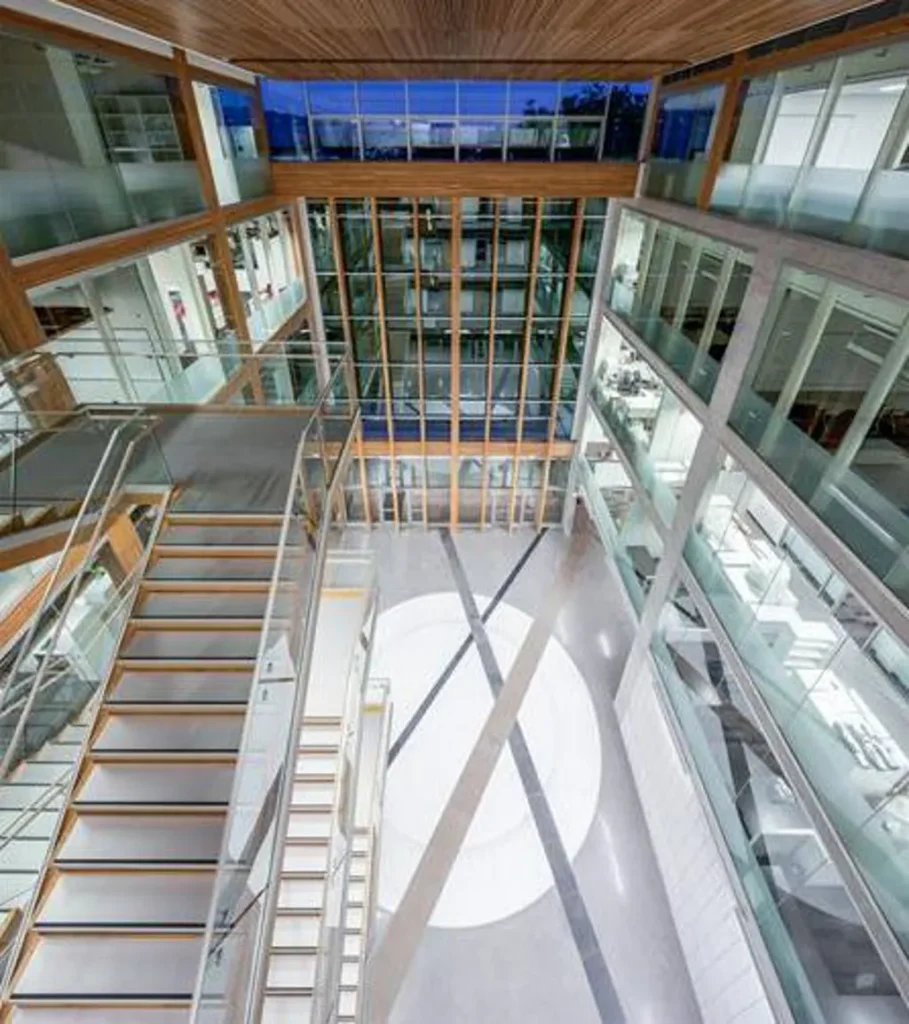
In the quest to decarbonize the construction sector, a groundbreaking study has emerged from the University of British Columbia (UBC), offering a promising pathway to sustainable structural systems. The research, led by Yang Li from the Department of Wood Science in UBC’s Faculty of Forestry, focuses on Glued-Laminated Timber (Glulam), a renewable and versatile building material. Published in the Journal of Wood Science (known in English as the Journal of Wood Science), the study provides a dynamic life cycle assessment (DLCA) of Glulam manufactured in British Columbia, highlighting its potential as a low-carbon alternative to traditional materials like steel and concrete.
The construction industry is a significant contributor to global greenhouse gas (GHG) emissions, accounting for approximately 33% of the total. As the world grapples with climate change, the environmental footprint of building materials has become a critical area of focus. Li’s research addresses this concern by evaluating the cradle-to-gate environmental impacts of Glulam under current and evolving scenarios.
The study employs a hybrid methodology that combines process-based life cycle assessment (LCA) with a system dynamics (SD) model. Real-time production data from a Glulam facility in Castlegar, BC, were integrated with region-specific energy and forestry profiles. The assessment was conducted using the ReCiPe 2016 Midpoint (E) method, a comprehensive approach that considers various environmental impact categories.
The results are compelling. The Global Warming Potential (GWP) of BC Glulam is significantly lower than comparable products in other regions. This is primarily due to the region’s hydroelectric-powered manufacturing processes and efficient clean wood waste recovery systems. “The environmental benefits of Glulam are substantial, especially when produced in regions with renewable energy infrastructure and sustainable forest practices,” Li explains.
The study also identifies key impact drivers, including transportation distances, adhesive type and usage, timber yield, and energy mix. These factors were analyzed through sensitivity analysis, providing valuable insights for manufacturers and policymakers. The system dynamics model projects the evolution of emissions, energy use, and waste generation from 2020 to 2050 under different demand and efficiency trajectories, offering a forward-looking perspective on the environmental performance of Glulam.
The findings underscore Glulam’s potential as a low-carbon structural alternative to steel and concrete. This is particularly relevant for the energy sector, which is increasingly focused on reducing embodied carbon in construction projects. By adopting Glulam, developers can significantly lower the carbon footprint of their buildings, contributing to broader decarbonization efforts.
Li’s research also provides policy insights to support the broader adoption of engineered wood products in climate-aligned construction. “Our study highlights the importance of integrating renewable energy and sustainable forest practices in the production of Glulam,” Li notes. “This can pave the way for a more sustainable and low-carbon construction industry.”
The implications of this research are far-reaching. As the world transitions to a low-carbon economy, the demand for sustainable building materials is expected to grow. Glulam, with its lower GWP and renewable characteristics, is poised to play a crucial role in this shift. The study’s findings can guide manufacturers, policymakers, and developers in making informed decisions that align with environmental goals and commercial interests.
In conclusion, Yang Li’s research offers a compelling case for the adoption of Glulam in sustainable construction. By providing a comprehensive assessment of its environmental impacts and identifying key drivers, the study paves the way for a more sustainable and low-carbon future in the construction industry. As the world continues to grapple with climate change, the insights from this research will be invaluable in shaping future developments in the field.