
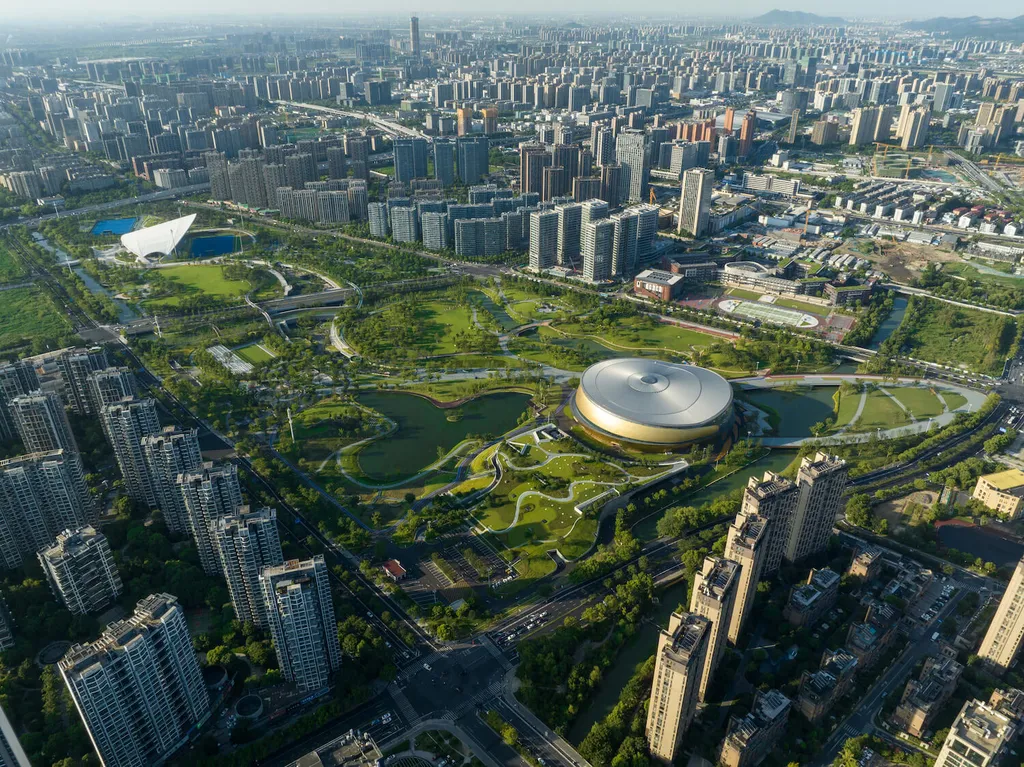
In the bustling coastal city of Qingdao, China, a unique study is making waves in the world of urban planning and architecture. Researchers, led by Rui Guan from the University of Nottingham Ningbo China, are using fractal theory to analyze the open spaces of urban bays, offering insights that could reshape how we design and utilize these vital areas.
Urban bays, often overlooked in favor of larger, more prominent spaces, play a crucial role in fostering a sustainable balance between urban development and natural environments. However, rapid urbanization driven by economic priorities has led to fragmented spatial hierarchies and uneven distributions of open spaces, limiting their ability to cater to diverse user needs.
Guan and his team focused on two contrasting bays in Qingdao: Qingdao Bay, which has evolved over time, and Fushan Bay, a product of modern development. By employing grid fractal dimension analysis, box-counting methods, and GIS tools, they quantified the fractal characteristics of these spaces, identified scale discontinuities, and evaluated spatial balance.
Their findings reveal that Qingdao Bay exhibits a fractal dimension of 1.784, closely aligning with ideal urban fractal patterns. In contrast, Fushan Bay’s higher fractal dimension of 1.839 indicates excessive spatial fragmentation. “This fragmentation disrupts the scale continuity and limits the functionality of the open spaces,” explains Guan. “It’s like having a beautiful park but missing the smaller, more intimate spaces where people can truly connect with their environment.”
The study highlights key issues such as oversized coastal parks that disrupt scale continuity, a lack of human-scale interaction spaces, and homogeneous functional zoning. To address these challenges, the researchers propose a fractal-optimized hierarchical framework that emphasizes multi-scale integration, transitional spaces, and mixed-use planning.
The implications of this research extend beyond urban planning. For the energy sector, understanding and optimizing the spatial organization of urban bays can lead to more efficient and sustainable energy use. For instance, well-designed open spaces can enhance natural ventilation and reduce the urban heat island effect, lowering the demand for energy-intensive cooling solutions.
Moreover, the study’s application of fractal theory to small-scale coastal systems offers a novel approach to spatial optimization. “By understanding the underlying patterns and structures, we can create spaces that are not only aesthetically pleasing but also functionally superior,” says Guan.
Published in the *Journal of Asian Architecture and Building Engineering* (known in English as the *Journal of Asian Architecture and Building Engineering*), this research provides actionable insights for enhancing spatial quality in similar urban bay contexts. As cities continue to grow and evolve, the principles outlined in this study could shape the future of urban development, fostering a harmonious balance between human activity and natural environments.
In an era where sustainable and efficient urban planning is more critical than ever, Guan’s work offers a fresh perspective that could inspire innovative solutions for cities around the world. By embracing the complexities and intricacies of urban bays, we can unlock their full potential, creating spaces that are not only beautiful but also functional, sustainable, and inclusive.