
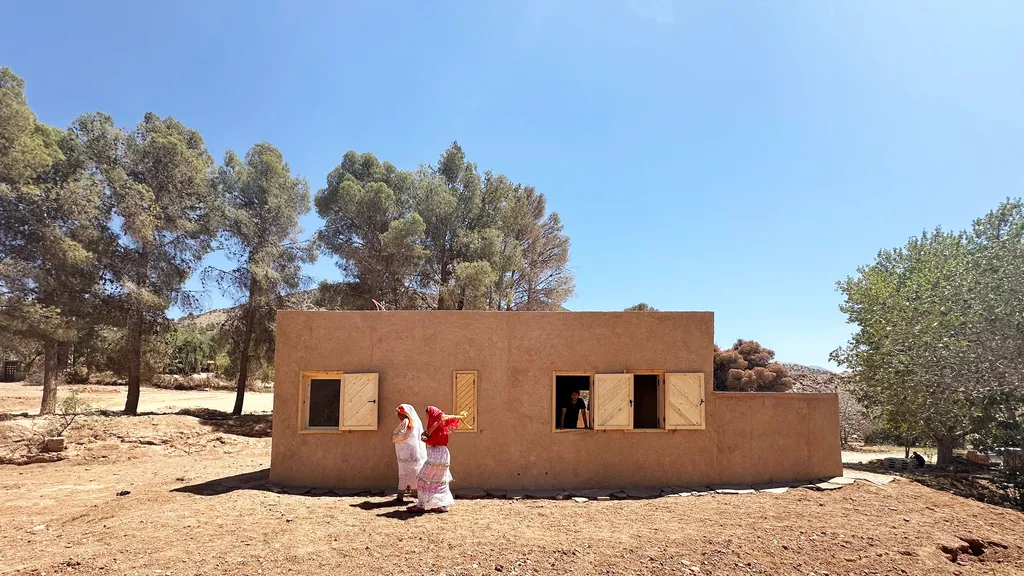
In the quest for sustainable construction materials, researchers have turned to an ancient building technique with a modern twist. A recent study published in *Scientific African* (translated as *African Science*) explores the optimization of adobe bricks reinforced with agricultural waste, offering a promising path toward low-carbon construction. The lead author, Abdelmounaim Alioui from the Laboratory of Industrial and Surface Engineering at Sultan Moulay Slimane University in Morocco, and his team have leveraged machine learning to enhance the thermomechanical performance of these eco-friendly bricks.
Adobe bricks, a staple in construction for millennia, are traditionally made from earth and organic materials. However, their use has been limited by trade-offs between strength and insulation. Alioui’s research addresses this challenge by incorporating straw and sawdust as reinforcing agents. The study reveals that small amounts of straw—just 1% or 2%—can significantly boost compressive strength, increasing it by up to 78%. “Adding straw improves the brick’s structural integrity, but too much can lead to excessive porosity, which weakens the material,” explains Alioui. Conversely, sawdust reduces mechanical strength but enhances insulation by lowering thermal conductivity, making the bricks more energy-efficient.
The team’s innovative approach goes beyond trial-and-error experimentation. By using machine learning, they developed predictive models to optimize the mix design of adobe bricks. The models achieved impressive accuracy, particularly for thermal conductivity, with an R² value as high as 0.991. “This methodology allows us to systematically explore different formulations and identify the best balance between strength and insulation,” says Alioui. The study highlights hybrid mixtures containing both straw and sawdust as the most balanced solutions, meeting the mechanical requirements of the Mexican adobe construction standard while improving thermal performance.
The implications for the energy sector are significant. As governments and industries worldwide push for greener building materials, this research offers a scalable solution that valorizes agricultural waste. “By repurposing straw and sawdust, we’re not only reducing construction costs but also contributing to a circular economy,” Alioui notes. The study’s findings could inspire further innovation in bio-based construction materials, particularly in regions with abundant agricultural waste.
The integration of machine learning into material science is a growing trend, and this research exemplifies its potential. By combining experimental data with artificial intelligence, Alioui and his team have created a framework that could revolutionize how sustainable building materials are developed. As the construction industry continues to evolve, this study serves as a blueprint for future advancements in eco-friendly construction.
Published in *Scientific African*, the research underscores the importance of interdisciplinary collaboration in addressing global challenges. With climate change and resource depletion at the forefront of public concern, the quest for sustainable construction materials has never been more urgent. Alioui’s work not only advances the field of low-carbon construction but also paves the way for a more resilient and energy-efficient future.