
In the heart of the Italian Alps, a groundbreaking study is challenging the way we think about construction and climate change. Researchers, led by Sebastian Brocco from the University of Innsbruck and the University of Milan, have been crunching numbers to see if swapping traditional building materials for timber could make a dent in greenhouse gas emissions. The results, published in the journal “Trees, Forests and People” (translated as “Trees, Forests and Humans”), are a mix of good news and a call to action.
The study zooms in on two regions, Valle Camonica and Valtellina, where forests aren’t just scenic backdrops but economic powerhouses. Brocco and his team wanted to see what would happen if they replaced mineral-framed homes with timber-framed ones, using locally sourced wood. “We’re talking about a shift that could have significant implications for the construction industry and the energy sector,” Brocco explains.
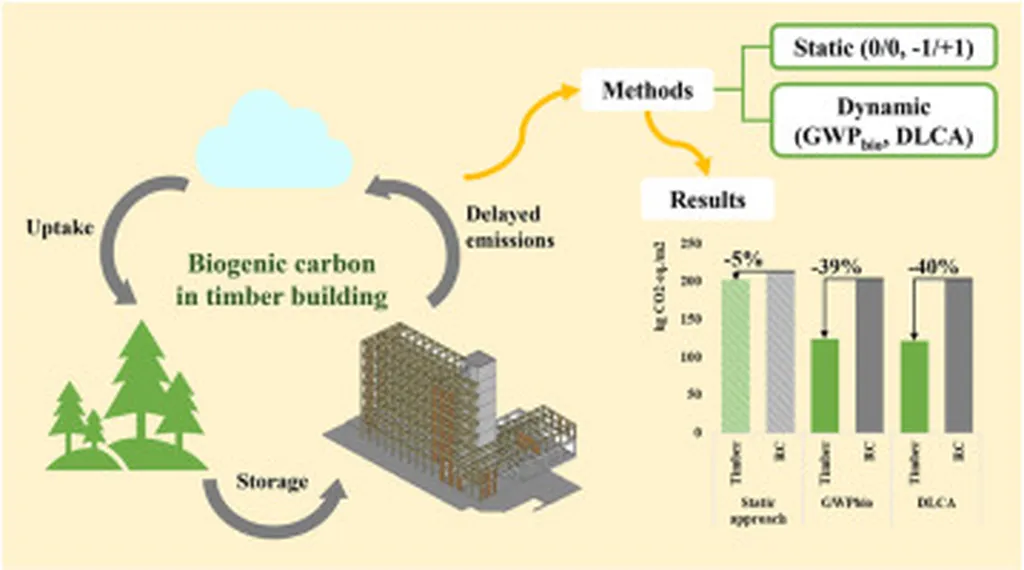
The findings are clear: using timber can make a big difference, but timing is everything. In the short term, swapping out concrete and steel for timber can lead to substantial emission reductions. The study estimates that this substitution could avoid up to 121 kg of CO2 equivalent emissions per square meter. However, as the production of mineral materials becomes cleaner over time, the benefits of timber substitution decrease. By 2050, the avoided emissions could drop to just 15.6 kg CO2eq per square meter.
But don’t let the long-term numbers fool you. Brocco emphasizes that timber-framed houses are still a powerful tool for reducing emissions during the construction phase. “The mitigation potential of timber declines as mineral material production becomes cleaner, but timber-framed houses offer an effective solution to reduce emissions during the construction phase,” he states.
The study also highlights the importance of sustainable forest management. The researchers found that the sustainable production from forests available for wood supply in the study area could result in 700 million kg of avoided CO2eq. This underscores the role of Alpine forests in supporting low-carbon construction during the transition.
So, what does this mean for the future? The research suggests that timber substitution is most effective in the short term, making it a crucial strategy for immediate climate action. As the energy sector works towards decarbonization, the construction industry could play a significant role in reducing emissions by embracing timber-framed buildings.
Brocco’s work is a reminder that the fight against climate change requires innovative thinking and a willingness to challenge the status quo. By understanding the trade-offs and opportunities in timber substitution, we can make smarter choices that benefit both the planet and the economy. As the construction industry looks to the future, this study provides a roadmap for how timber can be a key player in the transition to a low-carbon world.