
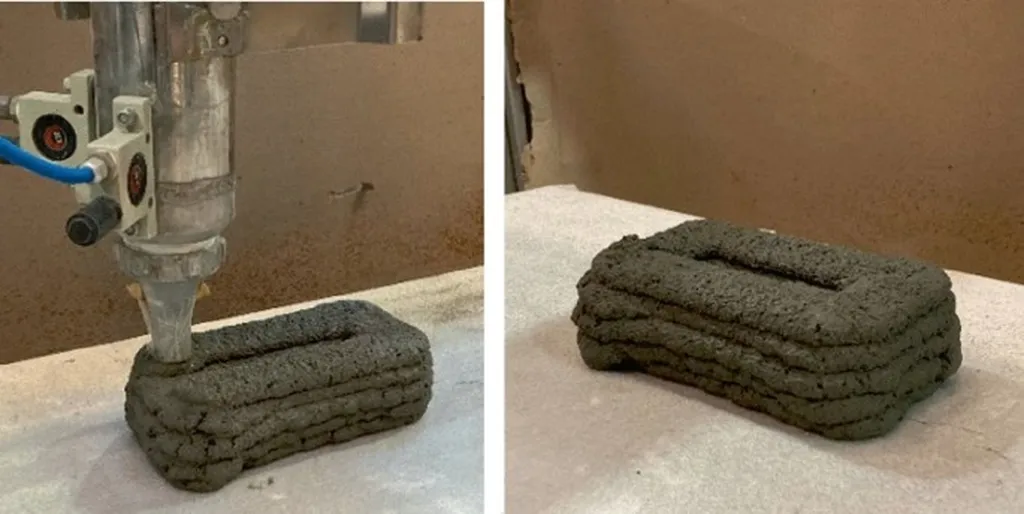
In the quest for sustainable construction materials, researchers have turned to an unlikely ally: sugarcane. A recent study led by A. H. M. Javed Hossain Talukdar from the Group of Sustainable Engineered Construction Materials at Queensland University of Technology has explored the potential of sugarcane bagasse ash (SCBA) as a low-carbon binder in 3D printed concrete. The findings, published in the journal *Buildings* (which translates to *Gebouwen* in English), could pave the way for greener construction practices in the energy sector and beyond.
Sugarcane bagasse ash, a byproduct of the sugarcane industry, has been underutilized despite its potential as a supplementary cementitious material. Talukdar and his team investigated its use in 3D concrete printing (3DCP), replacing up to 25% of the traditional binder. The study also examined the impact of adding polypropylene (PP) and steel (ST) microfibers to the mix.
The results were promising. “Increasing the SCBA content led to greater slump and improved flowability,” Talukdar explained. “We also observed a slower rate of static yield stress development, with up to a 90 percent reduction compared to the control mix.” This means that the SCBA-based mortar is easier to work with and more suitable for 3D printing processes.
The addition of PP fibers doubled the static yield stress in mixes containing 20 percent SCBA, enhancing the material’s structural integrity. Moreover, the mix with 10 percent SCBA achieved the highest mechanical strength, both in compression and flexure, due to its denser microstructure and enhanced pozzolanic reaction.
So, what does this mean for the construction industry? The use of SCBA in 3DCP could significantly reduce carbon emissions, as it replaces a portion of the traditional cement binder. This is particularly relevant for the energy sector, where the demand for sustainable and low-carbon construction materials is growing.
“Our findings suggest that SCBA has great potential as a sustainable binder in 3DCP,” Talukdar said. “This could lead to more environmentally friendly construction practices and contribute to the circular economy by utilizing industrial byproducts.”
The study’s insights could shape future developments in the field, encouraging further research into alternative binders and recycled materials. As the construction industry continues to seek sustainable solutions, the use of SCBA in 3DCP offers a promising avenue for reducing carbon emissions and promoting greener practices.
In the words of Talukdar, “This is just the beginning. There’s so much more to explore in the realm of sustainable construction materials.” And with these findings, the industry is one step closer to a more sustainable future.