
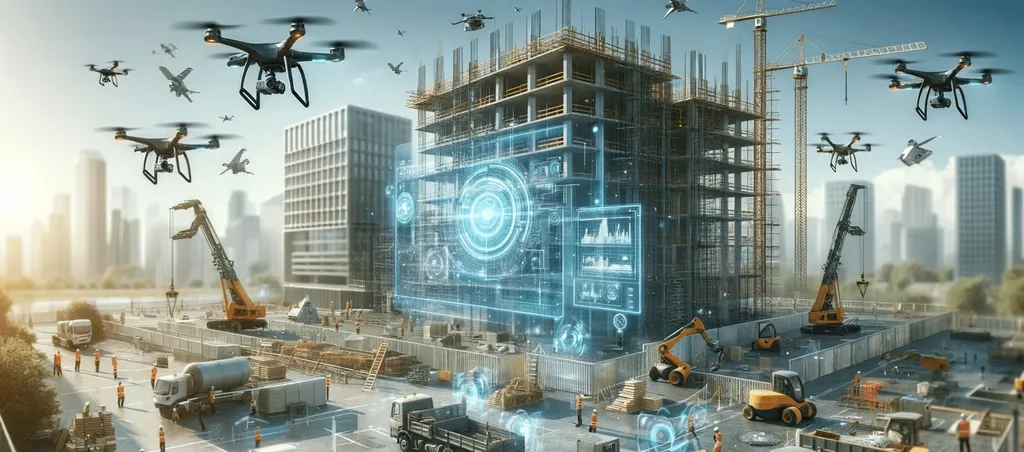
The construction industry is undergoing a seismic shift, one that is redefining the very essence of how we build. At the heart of this transformation is the integration of advanced artificial intelligence (AI) systems into construction equipment, a development that is fundamentally altering the way projects are planned and executed. This technological revolution is not merely about automating tasks; it is about creating a new paradigm for equipment coordination, predictive maintenance, and operational efficiency that transcends traditional manual operations.
The integration of autonomous capabilities into construction equipment represents a convergence of multiple technological disciplines. These systems can process environmental data, make real-time decisions, and coordinate complex multi-machine operations without continuous human oversight. This is not a distant future scenario but a reality that is already being deployed across diverse construction environments. The technological foundation of these machine intelligence systems is built on decades of research in AI, sensor technology, and industrial automation, now reaching maturity levels that enable practical deployment.
Modern autonomous construction equipment operates through sophisticated classification frameworks that define operational capabilities across multiple independence levels. The Society of Automotive Engineers has established standardized autonomy levels ranging from Level 0 (manual operation) through Level 4 (full automation), with construction-specific adaptations addressing unique jobsite requirements and safety protocols. Level 2 systems provide partial automation with human oversight, enabling automated functions like grade control while requiring operator supervision. Level 3 capabilities allow conditional automation where machines handle specific tasks independently but require human intervention for complex scenarios. Level 4 systems achieve full operational independence within defined parameters, processing sensor data and making operational decisions without human input while maintaining safety protocols and emergency override capabilities.
Edge computing networks form the technological backbone of autonomous equipment operations, processing massive sensor data streams directly on individual machines rather than relying on external connectivity. This distributed processing approach enables instantaneous decision-making even in environments with limited communication infrastructure, ensuring continuous operation across remote construction sites. According to Caterpillar’s technical specifications, autonomous systems integrate LiDAR technology, radar arrays, multi-frequency GPS positioning, and high-resolution camera networks to create comprehensive environmental awareness. These sensor arrays generate continuous 360-degree digital representations of jobsite conditions, updating in real-time to reflect changing obstacles, personnel locations, and operational parameters.
The AI algorithms powering these systems draw from over 30 years of automation research and real-world deployment experience. Machine learning models trained on millions of operational hours enable dynamic obstacle recognition, adaptive path planning, and predictive maintenance scheduling that optimizes equipment performance while minimizing downtime risks. These advancements are now being adapted for construction applications, processing terabytes of environmental data using specialized processors designed for industrial applications.
The hardware architecture enabling machine independence combines multiple sensor technologies into unified perception systems that maintain operational reliability under challenging construction conditions. Multi-sensor fusion platforms integrate positioning data from GPS networks with environmental scanning from LiDAR arrays, obstacle detection from radar systems, and visual processing from high-resolution camera networks. Onboard computing units process terabytes of environmental data using specialized processors designed for industrial applications. These systems maintain operational capability in extreme temperatures, high vibration environments, and dust-heavy conditions typical of construction sites. Moreover, redundant safety systems ensure fail-safe operations through multiple independent monitoring networks that can trigger emergency stops or transfer control to human operators when anomalous conditions are detected.
Communication modules enable vehicle-to-vehicle coordination through standardized protocols that allow different equipment types to share operational data, coordinate travel paths, and optimize collective productivity. Fleet management systems like Cat VisionLink™ and Cat MineStar™ provide centralized oversight capabilities while maintaining individual machine autonomy for routine operations.
Advanced sensor technology integration is crucial for the effective operation of autonomous construction equipment. LiDAR arrays provide precise distance measurement and spatial mapping capabilities that create detailed three-dimensional representations of jobsite terrain and obstacles. These systems operate effectively in various lighting conditions and weather environments, maintaining consistent accuracy for navigation and obstacle avoidance applications. Radar technology enables relative velocity measurement and obstacle detection capabilities that complement visual sensor systems. Multi-frequency radar arrays can distinguish between stationary objects, moving equipment, and personnel, providing essential data for collision avoidance and path optimization algorithms. GPS positioning systems utilize multi-frequency receivers and differential correction networks to achieve sub-meter accuracy required for precision grading and material placement operations. Integration with inertial measurement units provides continuous position tracking even during temporary GPS signal interruptions.
The deployment of autonomous construction equipment varies significantly across different machine types, with some categories achieving higher autonomy levels due to operational characteristics and safety requirements. Mining industry crossover has accelerated development in specific equipment categories, particularly haul trucks and excavators that share operational similarities between mining and construction applications.
Autonomous excavators represent sophisticated integration of precision control systems with environmental awareness capabilities. These machines can perform autonomous trenching operations by following pre-programmed grade specifications while continuously monitoring for underground utilities and soil condition changes. Loading operations require precise bucket positioning relative to haul trucks, demanding coordination between multiple machine control systems. Precision grading applications utilize continuous blade height control relative to finished grade specifications, achieving tolerances measured in centimeters rather than traditional operator-dependent