
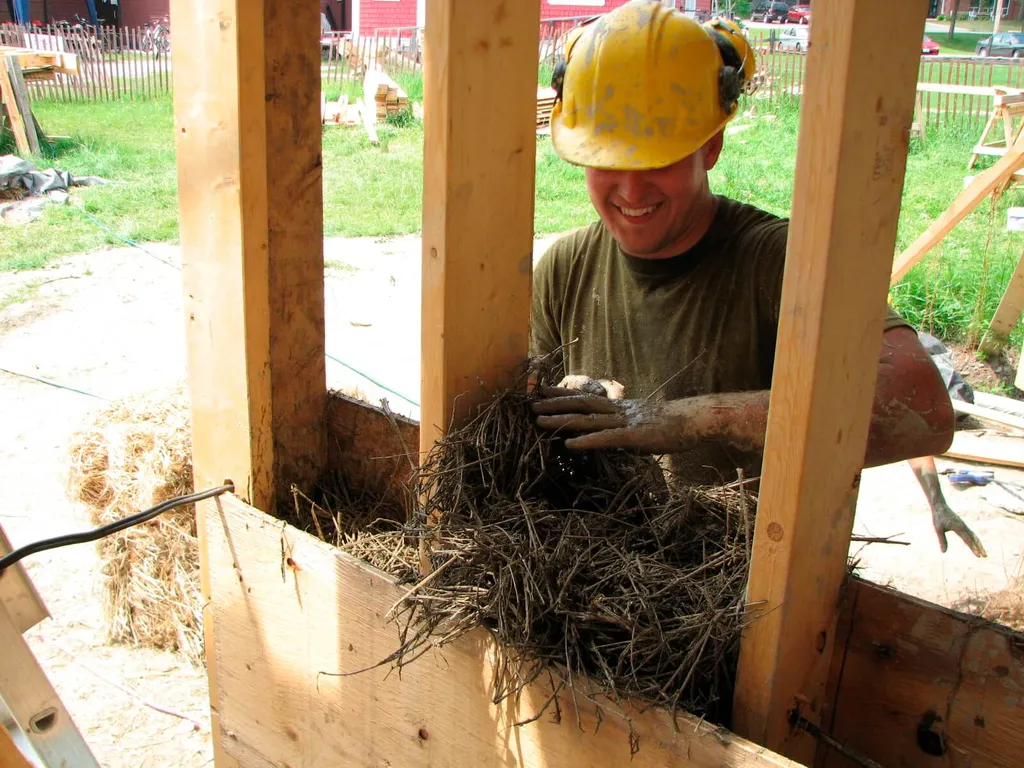
In the quest for sustainable construction materials, a recent study has shed light on the thermal performance of light-clay materials, offering promising insights for the energy sector. Published in the Journal of Architectural Sciences and Applications (Mimarlık Bilimleri ve Uygulamaları Dergisi), the research conducted by Bengü İtmeç from Yaşar University compares the thermal conductivity of hemp and straw fibers in light-clay composites, providing valuable data for architects and builders aiming to enhance energy efficiency in buildings.
The study, which marks the first volume-based comparison of hemp and straw fibers in light-clay panels, reveals that the type and amount of fibers used significantly impact the material’s density and thermal conductivity. “We found that hemp shives provide a lower thermal conductivity than straw for a similar composition,” explains İtmeç. “This is a crucial finding, as it indicates that hemp-based light-clay materials can be more efficient insulators, contributing to reduced energy consumption in buildings.”
The research demonstrates that hemp shive-based panels exhibit a thermal conductivity of 0.05 W/mK, compared to 0.11 W/mK for straw-based panels. Moreover, the low thermal conductivity measured for hempshive-based panels—up to 0.02 kg/m³—suggests that clay-based materials can be effectively utilized as sustainable insulation. This is a significant development, as the construction industry seeks to balance performance and sustainability.
The commercial implications of this research are substantial. As the energy sector increasingly prioritizes green building materials, the findings could drive demand for hemp-based light-clay composites. “This research opens up new possibilities for the use of agricultural waste in construction,” says İtmeç. “It’s not just about performance; it’s about creating a circular economy where waste materials are transformed into valuable resources.”
The study also highlights the importance of optimizing the composition of light-clay materials to achieve desired thermal properties. By understanding the impact of fiber type and density, architects and builders can make informed decisions that enhance the energy efficiency of buildings. This could lead to a reduction in heating and cooling costs, contributing to the overall sustainability of the built environment.
As the construction industry continues to evolve, the findings of this research could shape future developments in the field. By embracing sustainable materials like hemp-based light-clay composites, the industry can reduce its environmental footprint while improving the performance of buildings. This is not just a step forward for the energy sector; it’s a leap towards a more sustainable future.
In the words of İtmeç, “This research is a testament to the potential of innovative materials in driving sustainable construction. It’s an exciting time for the industry, and I believe we are just scratching the surface of what’s possible.” As the world grapples with the challenges of climate change, such innovations offer a beacon of hope, paving the way for a greener, more energy-efficient future.