
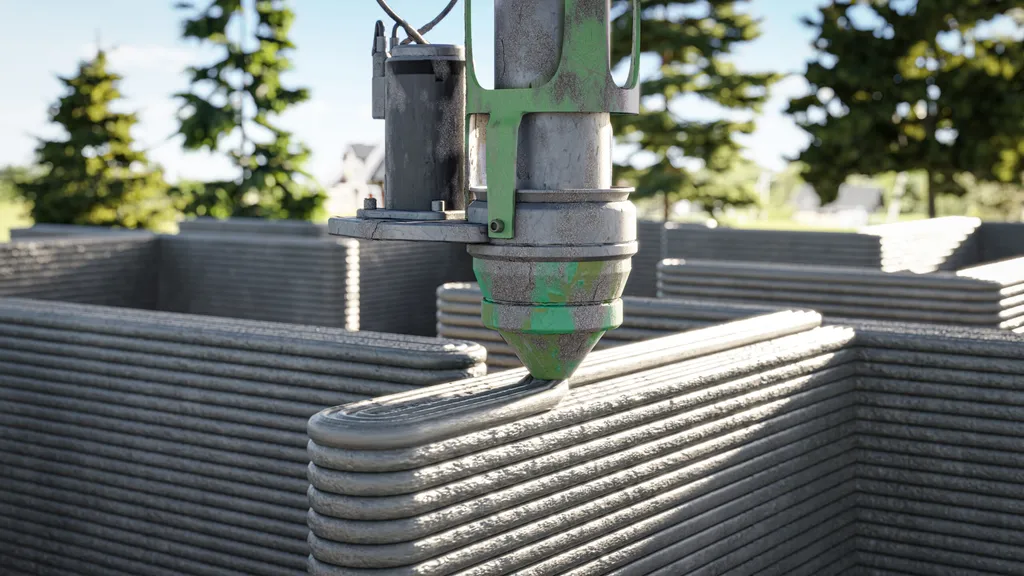
In the rapidly evolving world of construction technology, a groundbreaking study has emerged that could reshape how we build, particularly in the energy sector. Published in *Discover Civil Engineering* (translated to English as “Exploring Civil Engineering”), the research, led by Adamu Ajahunegn Agegn from the Department of Environmental Engineering at Addis Ababa Science and Technology University, delves into the transformative potential of 3D Concrete Printing (3DCP). This innovative approach promises to automate fabrication, slash material waste, and pave the way for more sustainable building solutions.
The study, a bibliometric and thematic analysis of global 3DCP research from 2015 to April 2025, utilized data from ScienceDirect and Dimensions databases. Using VOSviewer, the team mapped research trends, country collaborations, and thematic clusters, identifying four key focus areas: advancements in 3DCP technologies, innovations in material mix design, evaluation of mechanical and structural behavior of printed elements, and sustainability strategies through waste reduction and the use of recycled or alternative materials.
“3DCP is not just about printing concrete; it’s about reimagining the entire construction process,” Agegn said. “From reducing labor costs to minimizing environmental impact, the potential is immense.”
The findings reveal a rapid growth in 3DCP research, with increasing interdisciplinarity. However, challenges persist, including interlayer bonding, reinforcement, durability, digital workflow integration (such as Building Information Modeling, or BIM), and large-scale implementation.
For the energy sector, the implications are significant. 3DCP could revolutionize the construction of energy infrastructure, from wind turbine foundations to nuclear power plant components. The technology’s ability to create complex geometries with minimal waste could lead to more efficient and cost-effective energy solutions.
“Imagine constructing a wind turbine foundation with precise, optimized designs that reduce material use and enhance structural integrity,” Agegn explained. “This is not just a futuristic dream; it’s a reality we’re inching closer to every day.”
The study outlines priority directions for future work, emphasizing the need for resilient, cost-effective, and sustainable 3DCP applications in real-world construction. As the industry continues to evolve, Agegn’s research serves as a beacon, guiding the way toward a more efficient and sustainable future.
Published in *Discover Civil Engineering*, this study is a testament to the power of interdisciplinary research and the potential of 3DCP to transform the construction landscape. As we stand on the brink of a new era in building technology, Agegn’s work reminds us that the future is not just about innovation; it’s about collaboration, sustainability, and the relentless pursuit of progress.