
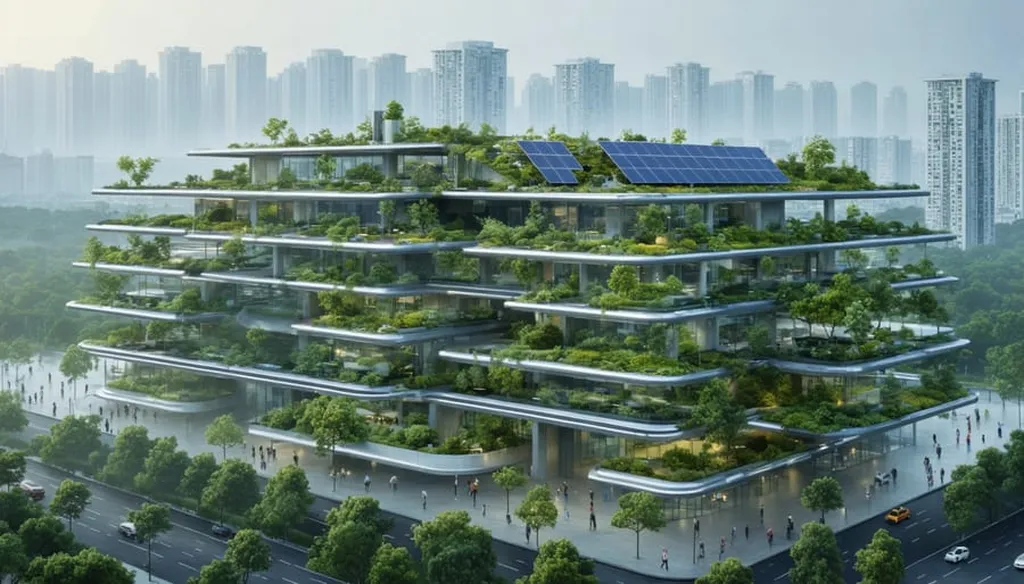
In the face of escalating climate change impacts, a groundbreaking study led by Mehdi Azimi from the Digital Architecture and Artificial Intelligence lab at Tarbiat Modares University in Tehran, Iran, is paving the way for climate-resilient, low-energy buildings. Published in the journal *Energy Conversion and Management: X* (formerly known as *Energy Conversion and Management: X*), Azimi’s research introduces a novel, system-based approach that synergistically integrates phase change materials (PCMs), adaptive shading, and predictive energy management systems (EMS) to revolutionize building design.
The study addresses a critical gap in current building design strategies, which often focus on isolated solutions rather than integrated systems. “Previous works have primarily investigated single-component solutions, but our approach uniquely provides a variety of scripts for different thermal sensor temperatures and window fractions to open and close in a closed-loop method,” Azimi explains. This holistic approach aims to achieve unprecedented resilience in indoor environmental quality (IEQ) by optimizing the interplay between PCM thermal buffering, adaptive shading, and predictive EMS.
Using parametric modeling (EnergyPlus) and future climate data (CC World 2080), Azimi and his team quantitatively demonstrate how a multilayer passive design can cope with increasing thermal stresses. The results are impressive: optimal PCM distribution (50% Q23 in walls) reduces the internal overheating degree (IOhD) by 54% compared to centralized applications. Coupling the PCM with an AI-based EMS, responsive to thresholds of 17–34°C and adaptive openness (0.1–0.9), further reduces the IOhD to 1.117—a 68% improvement over the baseline. The triple intervention system (PCM + 5-panel awning [0.4 m deep] + low-emissivity glazing) achieves a nearly neutral IOhD (0.979) under 2080 projections, outperforming standalone strategies.
The commercial implications of this research are substantial. As the energy sector increasingly prioritizes sustainability and resilience, integrated building design strategies like Azimi’s could become the gold standard. “The synergy of these two points to the optimal script, fraction, and sensor temperature, in conjunction with the optimal points and percentages of PCM use,” Azimi notes, highlighting the precision and adaptability of the approach.
This research not only advances the field of sustainable construction but also offers a roadmap for future developments. By demonstrating the efficacy of integrated passive cooling systems, Azimi’s work could inspire further innovation in building design, energy efficiency, and climate resilience. As the world grapples with the challenges of climate change, such advancements are crucial for creating buildings that are not only energy-efficient but also comfortable and resilient in the face of increasing thermal stresses.