
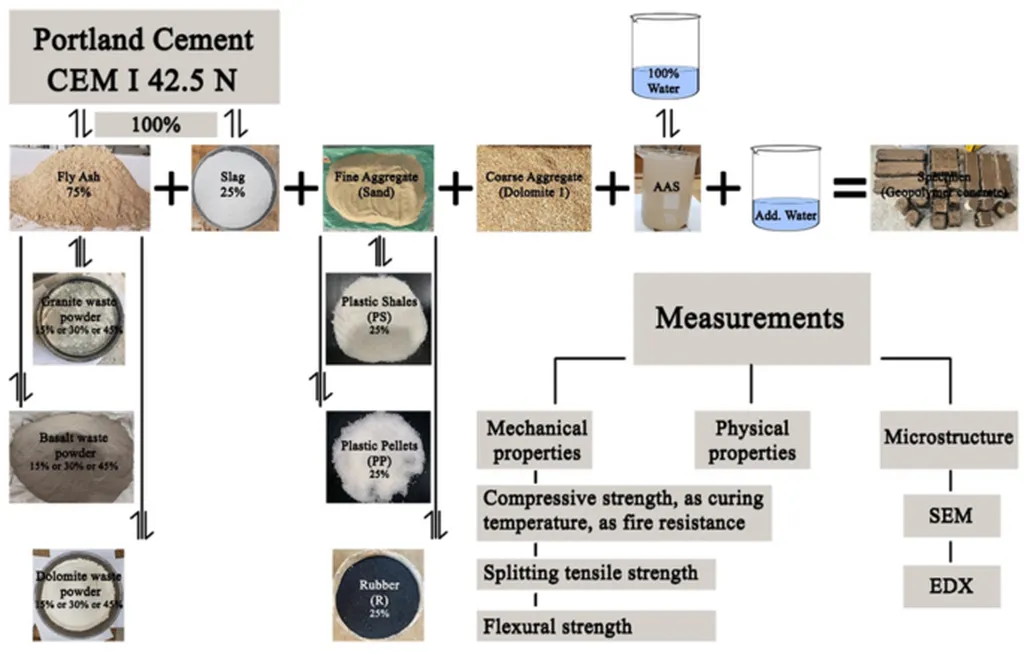
In the heart of Bosnia and Herzegovina, researchers are turning industrial waste into a promising construction material, potentially revolutionizing the energy sector’s approach to sustainable building. Dr. Nermina Bušatlić, from the University of Zenica’s Faculty of Engineering and Natural Sciences, has been leading a study that transforms fly ash and granulated blast furnace slag—byproducts of coal combustion and steel production, respectively—into eco-friendly geopolymers.
Geopolymers are inorganic polymers with a structure similar to natural minerals, known for their excellent mechanical properties and durability. Bušatlić’s team has been investigating how to synthesize these materials using industrial waste, aiming to reduce environmental impact and promote sustainability in construction.
The researchers activated the waste materials with alkaline solutions, creating geopolymer pastes and mortars. They found that adding up to 20% slag didn’t significantly affect the compressive strength of the geopolymer. “This is a crucial finding,” Bušatlić explains, “as it means we can incorporate a substantial amount of waste material without compromising the strength of the final product.”
Moreover, the compressive strengths of the geopolymer pastes were 30-50% higher than those of the mortars. Even more impressively, the compressive strengths of both pastes and mortars after just 2 and 7 days were twice as high as the standard values for cement mortars according to EN 197-1.
The chemical analysis confirmed the presence of high levels of silicon dioxide, aluminum oxide, and calcium oxide in the starting materials, contributing to the formation of a strong geopolymer structure. “This research indicates the potential of geopolymers as a sustainable and environmentally friendly alternative to conventional binders in construction,” Bušatlić states.
The implications for the energy sector are significant. As the world moves towards cleaner energy, the demand for sustainable construction materials is growing. Geopolymers could play a crucial role in this transition, offering a way to repurpose industrial waste and reduce the environmental impact of construction.
The study, published in the Journal of Mining and Metallurgy. Section A: Mining (known in English as “Rudarsko-metalurški zbornik”), opens up new avenues for research and development in the field of sustainable construction materials. It’s a testament to the power of innovation and the potential of waste materials to shape the future of the energy sector.
As the world grapples with the challenges of climate change and resource depletion, research like Bušatlić’s offers a glimmer of hope. It’s a reminder that with creativity and determination, we can turn waste into opportunity and pave the way for a more sustainable future.