
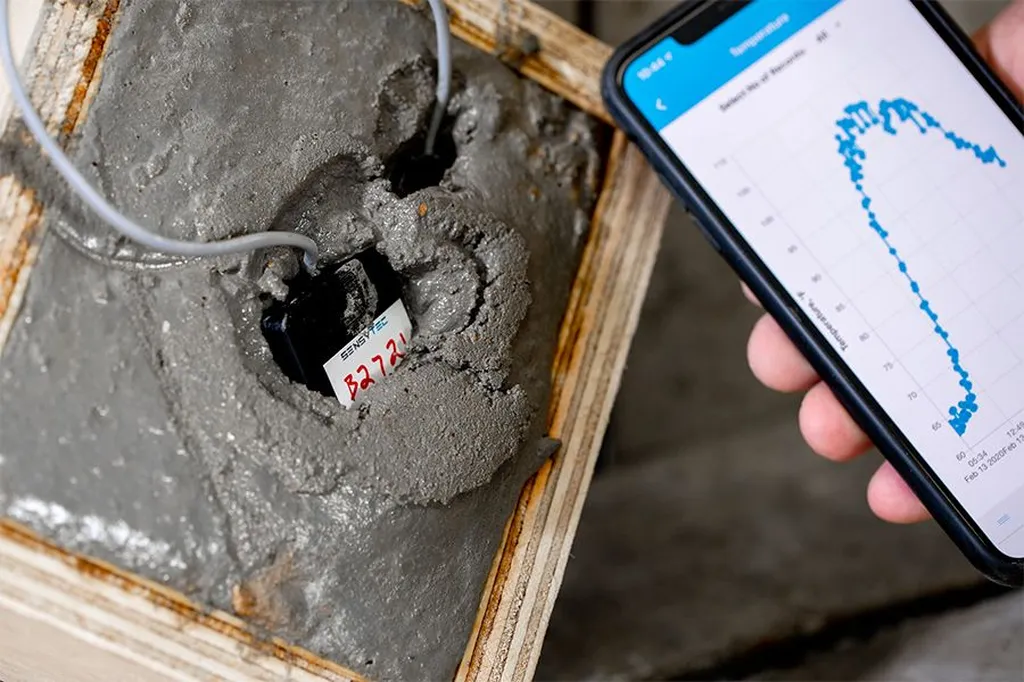
In the quest for sustainable infrastructure, a groundbreaking study led by Ramana P. V. from the Department of Civil Engineering at the Malaviya National Institute of Technology (MNIT) is paving the way for smarter, more resilient concrete structures. Published in the European Physical Journal Web of Conferences, the research introduces a novel framework that combines embedded piezoelectric sensors and artificial intelligence to monitor and predict the performance of low-carbon concrete blends.
The study focuses on blended concrete systems incorporating Ground Granulated Blast Furnace Slag (GGBS) and other supplementary cementitious materials (SCMs). These materials are increasingly important as the construction industry seeks to reduce its carbon footprint. The research utilises embedded piezoelectric sensors (EPS) based on the Electro-Mechanical Impedance (EMI) technique to gather real-time data on the concrete’s microstructural changes.
“Our approach allows for continuous, non-destructive monitoring of concrete structures,” explains Ramana P. V. “This is a significant step forward in structural health monitoring (SHM) and strength prediction, particularly for sustainable concrete systems.”
The experimental campaign involved three concrete systems: a control mix, a mix with a concrete enhancer, and a GGBS-enhanced slag mix. These were subjected to progressive mechanical damage and aggressive chemical exposures, simulating real-world conditions. The data collected from the EMI sensors were then analysed using machine learning models, including Random Forest (RF), Support Vector Machines (SVM), and Artificial Neural Networks (ANN).
The results were impressive. The Random Forest model achieved a regression accuracy of R² = 0.95 for strength prediction and 91% accuracy in classifying multistage damage states. This high level of accuracy confirms the viability of integrating EMI with machine learning for in-situ diagnostics.
One of the most compelling findings was the superior durability of the GGBS systems under coupled chemical and mechanical loading. “The GGBS systems exhibited remarkable resistance to degradation, validating the durability benefits of slag inclusion,” notes Ramana P. V. This is a crucial insight for the energy sector, where infrastructure often faces harsh environmental conditions.
The study establishes EMI-ML as a scalable methodology for continuous performance monitoring and predictive maintenance of sustainable concrete structures. This aligns with the principles of the circular economy and digitised asset management, advancing the vision of next-generation intelligent infrastructure in the Industry 4.0 paradigm.
As the construction industry continues to evolve, this research offers a promising path forward. By enabling real-time monitoring and predictive analytics, it can help reduce maintenance costs, extend the lifespan of structures, and enhance safety. For the energy sector, this means more reliable and durable infrastructure, which is essential for supporting the transition to renewable energy sources.
In the words of Ramana P. V., “This research is not just about monitoring concrete; it’s about building smarter, more sustainable infrastructure for the future.” With the framework established in this study, the vision of intelligent, self-monitoring structures is becoming a reality.