
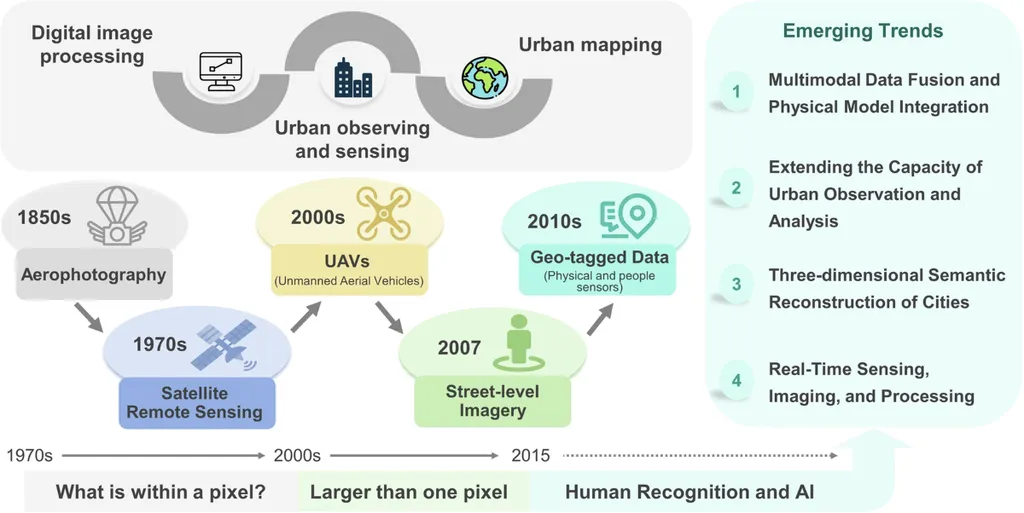
In the rapidly evolving world of urban development and energy management, the ability to accurately and efficiently detect buildings from aerial images is becoming increasingly crucial. A recent study led by S. Piltan Altaş from the Faculty of Engineering, Department of Geomatics Engineering at Karadeniz Technical University in Turkiye, delves into the impact of optimization techniques on the performance of U-Net-based building detection systems. Published in ‘The International Archives of the Photogrammetry, Remote Sensing and Spatial Information Sciences’—translated to English as ‘The International Archives of Photogrammetry, Remote Sensing and Spatial Information Sciences’—this research offers valuable insights that could reshape how we approach urban planning and energy sector applications.
As cities expand and rural-to-urban migration continues to surge, the demand for precise building detection grows. Manual detection methods are not only time-consuming but also prone to human error, making automation a compelling solution. Altaş’s study highlights the challenges associated with automatic building detection, particularly the generalization problem stemming from the diverse characteristics of roofs in complex environments. “The variability in roof types and structures poses a significant hurdle in developing a one-size-fits-all solution,” explains Altaş. “Our research aims to address this by exploring different optimization techniques to enhance the accuracy and efficiency of building detection.”
The study focuses on the U-Net architecture, a popular deep learning model known for its effectiveness in image segmentation tasks. Altaş and his team investigated the effects of three optimization techniques—Adam, Nadam, and RMSprop—on the performance of U-Net in detecting buildings with different roof types. The findings reveal that the choice of optimization technique can significantly impact both computational costs and performance metrics, offering a nuanced understanding of how to optimize these systems for real-world applications.
For the energy sector, the implications are substantial. Accurate building detection is essential for urban planning, energy distribution, and infrastructure development. By improving the efficiency and accuracy of building detection algorithms, energy companies can better assess demand, optimize resource allocation, and plan for future growth. “The energy sector stands to benefit greatly from advancements in building detection technology,” says Altaş. “More precise data leads to more informed decisions, ultimately driving efficiency and sustainability.”
The research underscores the ongoing need for experimental approaches in the field of deep learning. While no single optimization algorithm is universally optimal, understanding the strengths and limitations of different techniques can pave the way for more robust and adaptable solutions. As Altaş notes, “Our study is a step towards bridging the gap between theoretical models and practical applications, providing a foundation for future research and development.”
In conclusion, Altaş’s work not only sheds light on the current state of building detection technology but also points to future directions for innovation. As cities continue to grow and energy demands evolve, the insights gained from this research will be invaluable in shaping the tools and technologies that will drive progress in the years to come.