
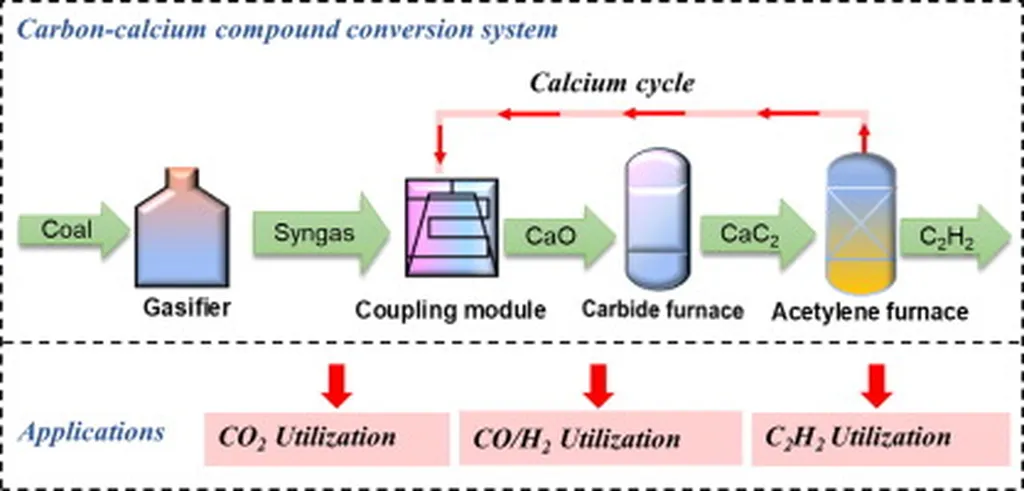
In the quest to mitigate global CO2 emissions, a team of researchers led by Wenjie Gong from the State Key Laboratory of Silicate Materials for Architectures at Wuhan University of Technology has uncovered promising avenues for turning industrial waste into valuable resources while sequestering carbon dioxide. Their work, published in the journal *Cleaner Materials* (which translates to *Cleaner Materials* in English), explores the potential of calcium carbide slag (CS) in CO2 mineralization, a process that could revolutionize the construction and energy sectors.
Calcium carbide slag, a byproduct of acetylene production, is primarily composed of calcium hydroxide (Ca(OH)2), which offers high alkalinity and calcium content—ideal for reacting with CO2 to form stable carbonate minerals. This process, known as carbonation, not only sequesters CO2 permanently but also produces valuable by-products, making it a win-win for the environment and industry.
“CO2 mineralization using carbide slag is a promising pathway for carbon capture and utilization,” Gong explains. “It transforms an industrial waste into a resource, creating high-value products while reducing greenhouse gas emissions.”
The research delves into various carbonation methods, including direct, indirect, and advanced techniques. Direct carbonation, for instance, yields calcium carbonate (CaCO3) suitable for large-scale industrial applications, such as construction materials. Indirect and advanced methods, on the other hand, enhance product purity and functionality, opening doors to specialized applications like high-value nano-calcium carbonates and energy storage solutions.
Operational parameters such as temperature, concentration, humidity, and additives play a crucial role in optimizing carbonation efficiency and product properties. By fine-tuning these parameters, researchers can tailor the process to meet specific industrial needs, making it a versatile tool for CO2 management.
The implications for the energy sector are significant. As the world grapples with the need to reduce CO2 emissions, innovative solutions like CS carbonation offer a sustainable and economically viable pathway. By integrating CO2 mineralization into industrial processes, companies can not only mitigate their environmental impact but also create new revenue streams from the by-products.
“This research highlights the potential of industrial symbiosis,” Gong notes. “By utilizing waste materials and sequestering CO2, we can create a circular economy that benefits both the environment and industry.”
As the world continues to seek effective strategies for carbon capture and utilization, the work of Gong and his team offers a beacon of hope. Their findings pave the way for future developments in sustainable material innovation and CO2 management, shaping a greener and more prosperous future for all.