
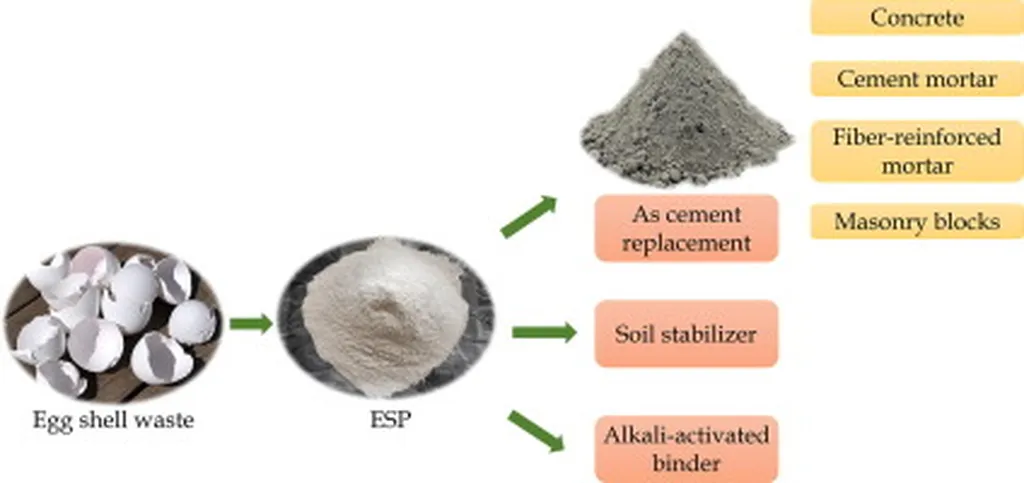
In a world where sustainability is no longer a choice but a necessity, researchers are turning to unconventional sources for innovative solutions. One such breakthrough comes from Dinesh Srirama and his team at the National Institute of Technology Andhra Pradesh, who have discovered a novel use for eggshell waste in soil stabilization. Published in the journal ‘Next Materials’ (which translates to ‘New Materials’), their research opens up exciting possibilities for the construction and energy sectors.
The study focuses on the potential of eggshell waste, a rich source of calcium carbonate, as a sustainable alternative to traditional limestone in soil stabilization. “We were intrigued by the idea of repurposing a waste material that is often discarded,” says Srirama. “Eggshells are abundant and readily available, making them an ideal candidate for this purpose.”
The researchers characterized the physical, mineralogical, and chemical properties of quicklime and hydrated lime derived from chicken eggshells. They found that both eggshell quicklime (EQL) and eggshell hydrated lime (EHL) meet ASTM standards, making them suitable for use in construction. Moreover, the team compared the mechanical performance of EHL with commercial hydrated lime (CHL) at various dosages, with remarkable results.
“At a 7% lime dosage, we observed significant improvements in unconfined compressive strength, California bearing ratio, cohesion, and internal friction angle,” explains Srirama. “Most notably, EHL outperformed CHL, demonstrating enhanced performance in all these areas.” These findings suggest that eggshell-derived lime could be a viable and sustainable solution for soil stabilization, offering a way to reduce dependency on natural resources and minimize environmental impact.
The implications of this research are far-reaching, particularly for the energy sector. Soil stabilization is a critical aspect of infrastructure development, including the construction of roads, buildings, and energy facilities. By utilizing eggshell waste, companies can not only reduce their carbon footprint but also potentially lower costs associated with raw material extraction and processing.
“This research highlights the importance of thinking outside the box when it comes to sustainable practices,” says Srirama. “It’s about finding innovative ways to repurpose waste materials and turn them into valuable resources.”
As the world continues to grapple with the challenges of climate change and resource depletion, studies like this one offer a glimmer of hope. By embracing such innovative solutions, the construction and energy sectors can move towards a more sustainable future, one eggshell at a time. The research published in ‘Next Materials’ not only advances scientific knowledge but also paves the way for practical applications that could reshape industry standards and practices.