
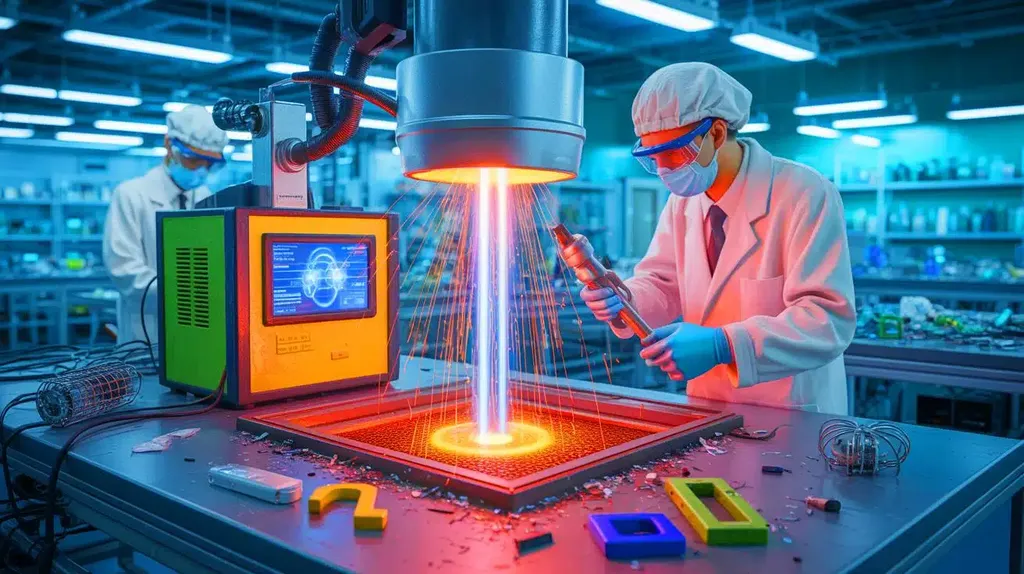
In the quest for advanced materials that can revolutionize the energy sector, a novel technique known as Flash Joule Heating (FJH) is making waves. This innovative method, which rapidly heats carbon sources to ultra-high temperatures using high-energy current pulses, is opening new avenues for synthesizing graphene and other functional carbon materials. The research, led by Zhiwu Tan from the School of Engineering at Anhui Agricultural University in Hefei, China, and published in the journal *Carbon Energy* (which translates to *Carbon Energy* in English), is paving the way for more efficient and sustainable material production.
FJH stands out due to its solvent- and catalyst-free nature, high energy conversion efficiency, and short process cycle. These attributes make it a promising candidate for industrial-scale applications. “The technology demonstrates numerous advantages,” Tan explains, highlighting its potential to drive significant advancements in material science.
The process involves rapidly heating solid carbon sources to temperatures exceeding 3000 Kelvin. This intense heat drives the rapid rearrangement and graphitization of carbon atoms, resulting in materials with optimized microstructures. By adjusting parameters such as flash voltage and flash time, researchers can fine-tune the interlayer spacing of turbostratic graphene, defect concentration, and heteroatom doping. These optimizations enhance the performance of carbon materials in various applications, including composite reinforcement, metal-ion battery electrodes, supercapacitors, and electrocatalysts.
One of the most exciting outcomes of FJH is the synthesis of flash graphene, a form of graphene known for its exceptional properties. The technique also produces carbon nanotubes, graphene fibers, and anode hard carbon, each with unique characteristics that can be tailored to specific needs. “FJH can precisely optimize the microstructures of carbon materials,” Tan notes, emphasizing the versatility and potential of this method.
Despite its promise, FJH faces challenges, including low process yield, macroscopic material uniformity, and the need for a green power supply system. Addressing these issues is crucial for transitioning FJH from laboratory-scale experiments to industrial applications. “More research efforts are required to promote the transition of FJH from laboratory to industrial-scale applications,” Tan acknowledges, underscoring the need for continued innovation and investment.
The implications of this research are far-reaching. As the world seeks sustainable solutions for energy storage and management, advanced carbon materials synthesized through FJH could play a pivotal role. By providing innovative solutions for advanced carbon materials manufacturing and waste management, FJH could contribute significantly to achieving carbon neutrality.
In the energy sector, the ability to produce high-performance materials efficiently and sustainably is a game-changer. FJH offers a glimpse into a future where advanced materials are not only more effective but also more environmentally friendly. As researchers like Zhiwu Tan continue to push the boundaries of this technology, the potential for transformative impacts on the energy sector grows ever more promising.