
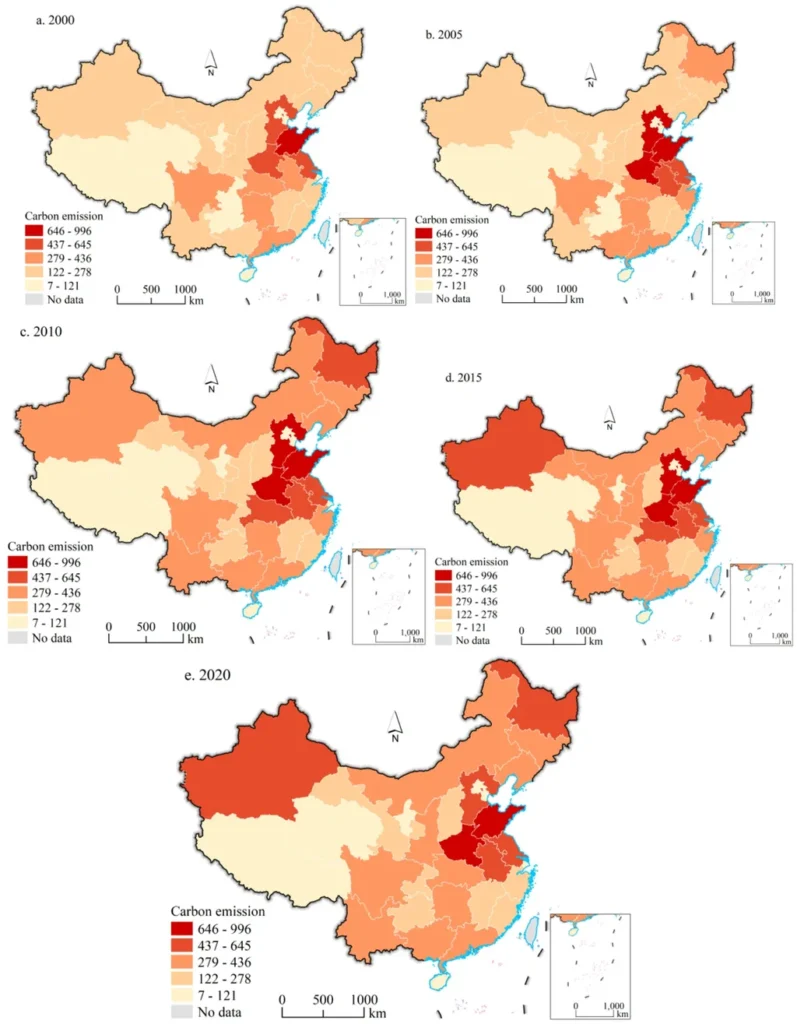
In the intricate web of China’s agricultural industry, a new study has uncovered the hidden pathways of carbon emissions, offering a roadmap for targeted emission reduction strategies. Led by Lehua Gao from the Marine Development Studies Institute of Ocean University of China, the research, published in the journal *Resources, Environment and Sustainability* (translated as *资源·环境·可持续发展*), provides a comprehensive analysis of the carbon flow within China’s agricultural sector, a critical industry that contributes significantly to the nation’s greenhouse gas emissions.
The study, which analyzed six years of input-output tables, reveals a three-phase evolution of agricultural carbon emissions: growth, peak, and plateau. “We found that 71.55% of emissions are concentrated in just four sectors: agriculture, food processing, food manufacturing, and fertilizer production,” Gao explains. This concentration presents a clear target for emission reduction efforts.
The research employs an integrated “input-output and complex network” coupling framework to map the transfer structure and evolutionary patterns of agriculture-related carbon emissions. It identifies the construction and basic chemical raw materials manufacturing sectors as the primary recipients of embodied carbon inflow, while electricity and heat production and supply, along with petroleum and nuclear fuel processing, are the core sectors for embodied carbon outflow.
The study also highlights the critical intermediary roles played by food processing and specialty chemical products manufacturing. “The ‘fertilizer manufacturing → agriculture’ pathway shows the highest carbon transfer volume,” Gao notes, “while ‘agriculture → food processing’ remains a stable high-carbon-flow route.” Notably, the “pesticide manufacturing → agriculture” pathway has intensified significantly since 2012.
The research offers valuable insights for the energy sector, particularly in understanding the shifting energy sources driving carbon emissions. At the upstream stage of the industrial chain, agriculture and the food processing industry are transitioning from reliance on petroleum-based fuels to electricity as the dominant energy source. This shift could have significant implications for energy providers and policymakers alike.
At the downstream stage, the study reveals that carbon emissions are highly concentrated in the paper and paper products industry, driven by consumption demand from food-related industries. This finding underscores the interconnectedness of various sectors and the need for a holistic approach to carbon management.
The study concludes with policy recommendations focused on enhanced technology adoption and optimized intermediate input management. These strategies could not only mitigate agricultural carbon emissions but also drive innovation and efficiency in the energy sector.
As China and other nations strive to meet their “dual carbon” goals—achieving peak carbon emissions before 2030 and carbon neutrality by 2060—this research provides a crucial foundation for understanding and managing the complex network of carbon flows within the agricultural industry. By shedding light on the transfer pathways and evolutionary patterns of embodied carbon emissions, the study offers a roadmap for targeted emission reduction strategies that could shape the future of agriculture and energy sectors alike.