
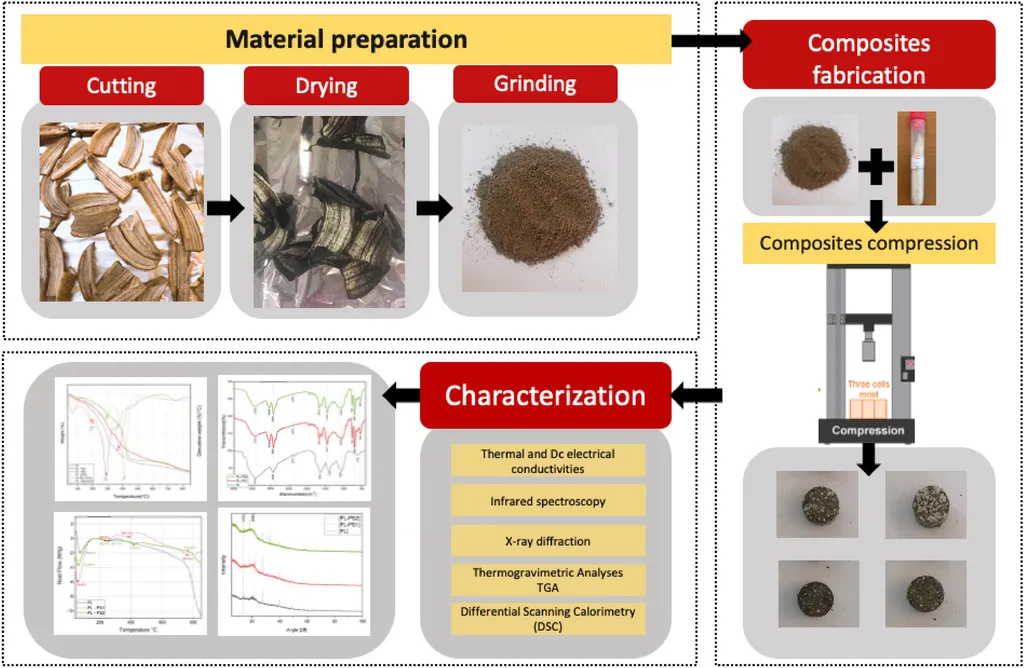
In the quest for sustainable construction materials, researchers have turned to an unlikely source: banana peels. A recent study published in *Rekayasa Sipil* (translated to English as “Civil Engineering”) explores the potential of banana peel-based biocomposites as an eco-friendly thermal insulation material for tropical buildings. Led by Deni Priansyah from the Airport/Aerospace Engineering department at the Trisakti Institute of Transportation and Logistics in Indonesia, the research offers promising insights into reducing carbon emissions in the construction industry.
The construction sector is a significant contributor to global carbon emissions, primarily due to the use of conventional materials with high thermal conductivity. This study highlights the need for sustainable alternatives that align with circular economy principles. Indonesia, as the world’s fourth-largest banana producer, generates vast amounts of banana peel waste, which can be repurposed as an eco-friendly thermal insulation material.
Priansyah and his team evaluated the thermal performance of a banana peel-based biocomposite (BP80-PS20) using numerical simulations on a simplified model of a tropical house. The key parameters analyzed included thermal conductivity, U-value, and R-value, benchmarked against Indonesian (SNI 6389:2011) and international (ASHRAE 90.1-2019) standards.
The results were impressive. The biocomposite significantly improved thermal resistance, reducing wall U-values from 2.97 to 0.68 W/m²K and partition U-values from 1.64 to 0.30 W/m²K. This corresponds to an increase of over 300% in R-value. The insulated building maintained indoor temperatures between 24.5°C and 27.2°C, well within the comfort zones specified by SNI and ASHRAE standards.
“This research demonstrates that banana peel waste can be transformed into a high-performance insulation material,” Priansyah explained. “It not only reduces waste but also enhances building energy efficiency, making it a viable option for sustainable construction in tropical climates.”
The commercial implications for the energy sector are substantial. As governments and industries worldwide strive to meet carbon reduction targets, the demand for sustainable building materials is on the rise. Banana peel biocomposites offer a cost-effective and environmentally friendly solution, particularly in regions with tropical climates.
Priansyah’s research suggests that this innovation could shape future developments in the field. “By integrating waste materials into construction practices, we can significantly reduce the environmental impact of the building sector,” he added. “This approach aligns with the principles of the circular economy, promoting resource efficiency and sustainability.”
The study published in *Rekayasa Sipil* underscores the potential of banana peel biocomposites to revolutionize thermal insulation in tropical buildings. As the construction industry continues to seek sustainable solutions, this research offers a compelling case for the adoption of eco-friendly materials derived from agricultural waste. The findings not only highlight the technical feasibility of banana peel biocomposites but also pave the way for further exploration and commercialization of similar innovations.