
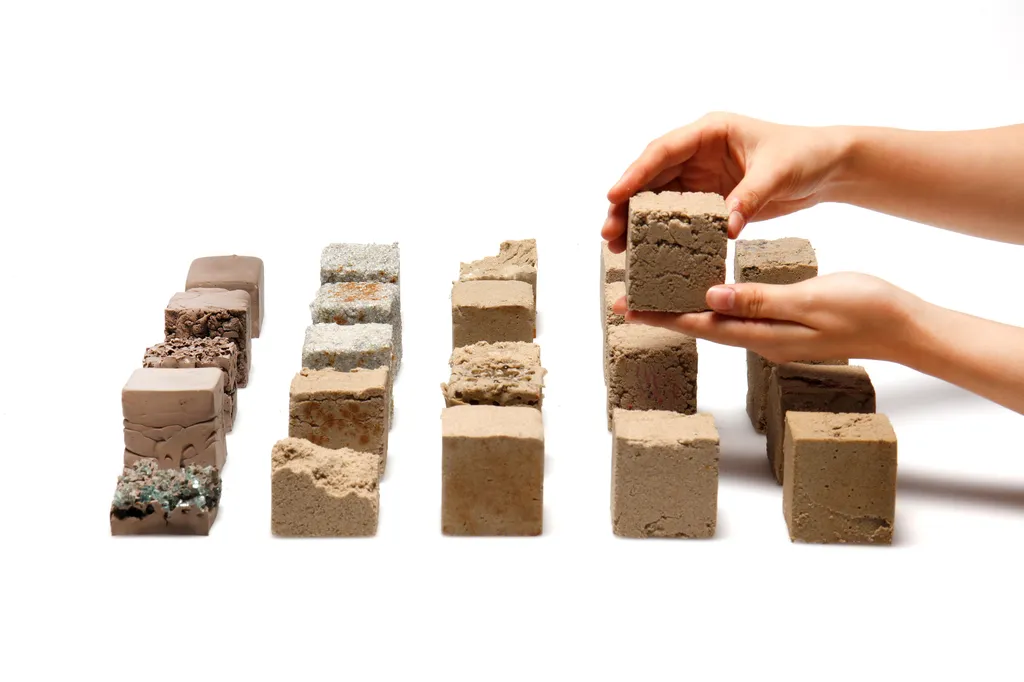
In the vast, windswept expanses of deserts, a groundbreaking approach to construction is taking root, promising to transform the way we build and combat desertification. Researchers, led by Yeshou Xu from the China-Pakistan Belt and Road Joint Laboratory on Smart Disaster Prevention of Major Infrastructures at Southeast University in Nanjing, China, have pioneered a method to create eco-friendly bricks from desert aeolian sand using microbial-induced calcium carbonate precipitation (MICP) technology. This innovation, published in the journal *Frontiers in Materials* (translated as “Materials Frontier”), could reshape the construction landscape and offer significant benefits to the energy sector.
Desertification is a global challenge, affecting over one-third of the Earth’s land surface. It leads to soil degradation, loss of biodiversity, and increased dust emissions, which contribute to climate change. Traditional construction materials, such as cement, have a substantial carbon footprint, exacerbating the problem. Xu and his team aim to address these issues by utilizing desert aeolian sand, a readily available resource, to create sustainable building materials.
The research focuses on the application of MICP technology, a process that uses microorganisms to bind sand particles together, forming a solid structure. “We employed Bacillus pasteurei, a type of bacteria, to induce calcium carbonate precipitation, which acts as a natural cement,” explains Xu. The team used an NH4-Ye medium at pH 9 to cultivate the bacteria and a stirring method for sand solidification. The results were promising, demonstrating successful consolidation of desert aeolian sand and improved mechanical properties of the resulting bricks.
The implications for the energy sector are substantial. Construction materials account for a significant portion of global CO2 emissions. By utilizing desert aeolian sand and MICP technology, the energy sector can reduce its carbon footprint and contribute to sustainable development. “This technology offers a green alternative to traditional construction materials,” says Xu. “It not only helps in rehabilitating degraded landscapes but also reduces CO2 and dust emissions associated with conventional construction materials.”
The potential applications extend beyond bricks. The technology can be used to stabilize soil, prevent erosion, and even create sustainable infrastructure in desert regions. This could open up new opportunities for energy projects in remote areas, where traditional construction methods are often impractical or environmentally damaging.
The research represents a significant step forward in the field of sustainable construction. As the world grapples with the challenges of climate change and desertification, innovations like this offer hope for a more sustainable future. “Our study demonstrates the potential of MICP technology in improving soil quality and augmenting the structural integrity of vast desert aeolian sand deposits,” Xu concludes. “This offers promising prospects for sustainable engineering applications.”
As the energy sector continues to evolve, the need for sustainable and eco-friendly solutions becomes increasingly urgent. The research led by Yeshou Xu provides a compelling example of how innovative technologies can address these challenges, paving the way for a more sustainable and resilient future. The publication of this research in *Frontiers in Materials* underscores its significance and potential impact on the field.