
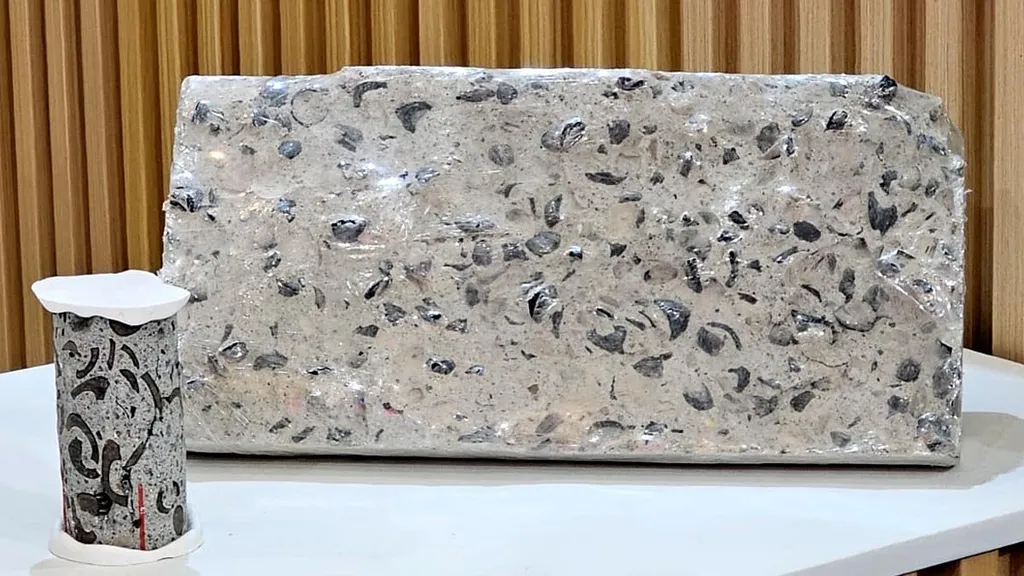
In the quest for sustainable construction materials, researchers have turned to an often-overlooked resource: recycled concrete powder (RCP). A recent study led by Sulpa Nurfaidah from the Department of Civil Engineering at Hasanuddin University in Indonesia, published in the *Journal of Engineering and Applied Science* (translated from Indonesian as *Jurnal Teknik dan Ilmu Terapan*), explores how RCP can enhance the durability of mortar, offering a promising path toward circular construction practices.
The global construction industry is under increasing pressure to reduce its environmental footprint. Traditional cement production is a significant contributor to CO₂ emissions, making the search for sustainable alternatives a priority. Nurfaidah’s research investigates how RCP, a byproduct of construction waste processing, can be repurposed as a supplementary cementitious material. By incorporating RCP into mortar, the study aims to reduce cement consumption and divert demolition waste from landfills.
The key to unlocking RCP’s potential lies in particle fineness, which influences reactivity, packing density, and microstructural development. Nurfaidah and her team evaluated the durability of mortars containing RCP with two particle sizes—RCP1 (passing sieve No. 200) and RCP2 (passing sieve No. 360)—at replacement levels of 0%, 15%, 20%, and 25%. The study measured porosity, water absorption, sorptivity, cohesion, and abrasion resistance at 28 and 90 days.
The results were revealing. “We found that RCP fineness and curing age significantly affected porosity, water absorption, and sorptivity,” Nurfaidah explained. “Finer RCP, particularly at higher substitution levels, led to a denser, more compact microstructure, enhancing long-term performance.” The study also highlighted that while compressive strength decreased with increasing RCP content, the finer RCP2 exhibited improved strength development over time due to secondary pozzolanic reactions and better particle packing.
The commercial implications for the energy sector are substantial. As the demand for low-carbon construction materials grows, RCP offers a cost-effective and environmentally friendly alternative to traditional cement. By optimizing RCP fineness, construction companies can balance strength, durability, and sustainability, reducing both material costs and carbon emissions.
Nurfaidah’s research underscores the importance of circular economy principles in the construction industry. “This study demonstrates that optimizing RCP fineness is essential to enhance the long-term performance of sustainable mortars,” she noted. “It’s a step toward a more sustainable future, where waste is minimized, and resources are used more efficiently.”
As the construction industry continues to evolve, the integration of recycled materials like RCP could reshape the sector’s approach to sustainability. By embracing these innovations, companies can not only reduce their environmental impact but also tap into new market opportunities driven by the growing demand for green building solutions. Nurfaidah’s work, published in the *Journal of Engineering and Applied Science*, provides a compelling case for the potential of RCP in low-carbon construction, paving the way for future developments in the field.