
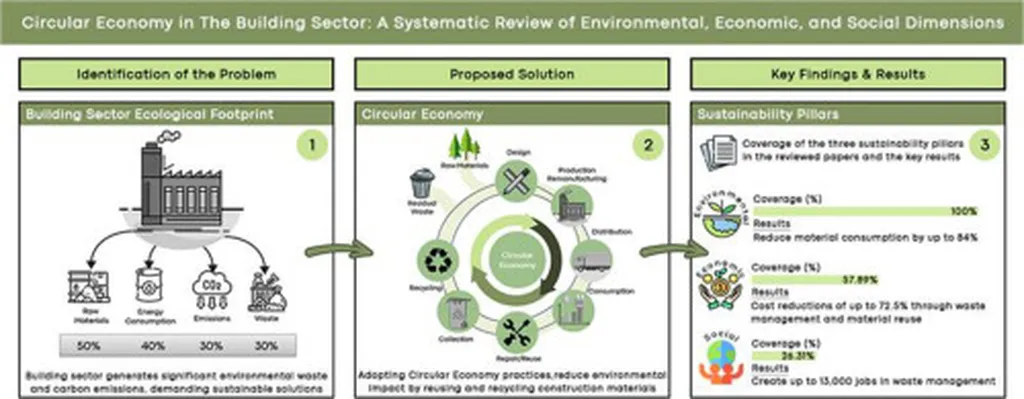
In the bustling urban landscapes of Ghana, a shift is brewing in the way consumers view their homes and the materials that build them. A recent study published in *Discover Civil Engineering* (which translates to *Udkunde Burgerlike Ingenieurswese* in Afrikaans) sheds light on the drivers behind consumer preferences and willingness to pay for circular buildings in urban Ghana. Led by Chris Kurbom Tieru from the Department of Construction Technology and Management at Cape Coast Technical University, the research offers a nuanced look at how sustainable urbanization can take root in emerging economies.
The global construction sector is under immense pressure to adopt circular economy principles, but until now, consumer demand in developing economies has been a bit of a mystery. Tieru’s study aims to change that. By integrating the Theory of Planned Behaviour and Value-Belief-Norm frameworks, the research provides a comprehensive analysis of consumer demand in sub-Saharan Africa. “We wanted to understand what drives Ghanaian consumers to prefer circular buildings and how much they are willing to pay for them,” Tieru explains. “This is crucial for aligning market supply with consumer expectations.”
The study conducted a cross-sectional survey of 200 respondents across four major cities in Ghana. Using factor analysis and regression models, the researchers identified latent drivers and barriers to circular construction. The findings revealed that energy efficiency and adaptability are top priorities for Ghanaian consumers, reflecting the cultural context of multigenerational households. “Energy efficiency is a big deal because it directly impacts the cost of living,” says Tieru. “Adaptability is also important as it allows buildings to evolve with the needs of the family over time.”
However, the study also uncovered significant barriers. Distrust in certification and material reuse emerged as major hurdles. Interestingly, consumer awareness of circular construction was the only significant predictor of willingness to pay (WTP), while preferences and barriers showed no effects. “This aligns with the evidence that knowledge predicts environmental investment willingness,” Tieru notes. “It’s a classic case of ‘you don’t know what you don’t know.'”
The WTP was highest for eco-communities and natural materials, with modest premiums overall. A key contribution of the study is the finding that Ghanaian consumers perceive circularity holistically, in contrast to the fragmented perceptions in high-income countries. “This holistic view is a game-changer,” Tieru says. “It means that consumers are not just looking at individual aspects like energy efficiency or material reuse, but at the overall sustainability of the building.”
The study recommends market interventions prioritising adaptability and efficiency, with government certification to rebuild trust. Consumer awareness through literacy programmes is also highlighted as a key factor in increasing WTP. “The findings help align policies to scale circular construction in Ghana and other similar economies,” Tieru concludes.
For the energy sector, this research offers valuable insights. As the demand for energy-efficient buildings grows, there is a significant opportunity for energy providers to innovate and meet these needs. The study’s emphasis on adaptability and efficiency could drive the development of new energy solutions tailored to the unique cultural and economic context of urban Ghana.
In the broader context, this research could shape future developments in the field of circular construction. By understanding consumer preferences and willingness to pay, developers and policymakers can create more sustainable and resilient urban environments. As Tieru puts it, “This is not just about building houses; it’s about building communities that are sustainable and adaptable to the needs of the people.”
Published in *Discover Civil Engineering*, this study is a step towards a more sustainable future, one circular building at a time.