
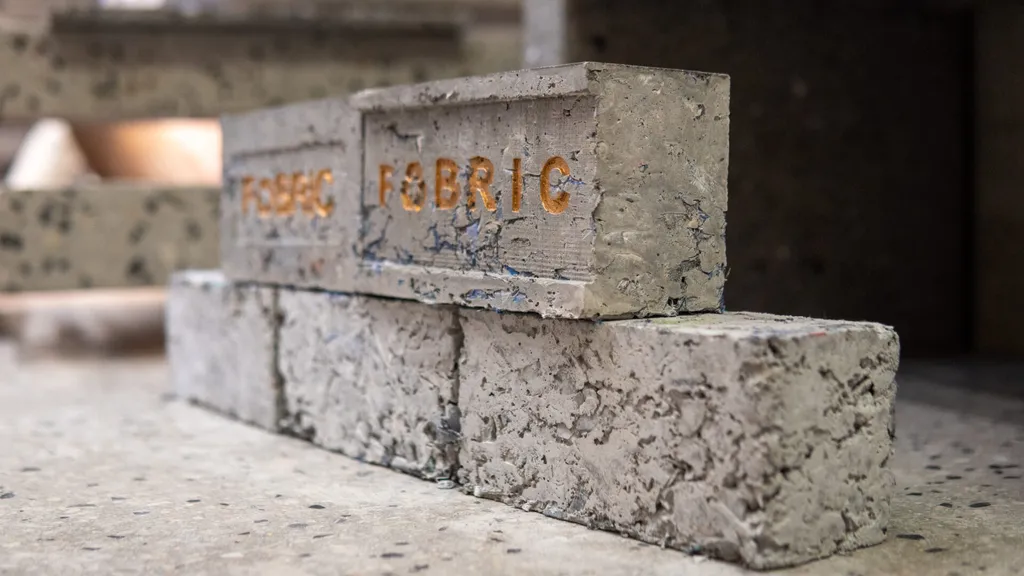
In the heart of South Africa, a groundbreaking study led by Thandiwe Sithole from the University of Johannesburg’s Department of Chemical Engineering is paving the way for a more sustainable construction industry. Sithole and her team have been exploring innovative ways to transform industrial waste into high-performance building materials, a crucial step towards a circular economy.
The research, published in the journal “Results in Engineering” (translated to English as “Results in Engineering”), focuses on the optimization of masonry blocks produced from waste foundry sand (WFS) and ground blast furnace slag (GBFS) through a process called alkali-activation. This method not only reduces waste but also produces materials with impressive mechanical properties.
Sithole explains, “We found that by carefully controlling the curing temperature, binder content, and water-to-solid ratio, we can significantly enhance the unconfined compressive strength (UCS) of these blocks.” The team discovered that the highest UCS of 16.7 MPa was achieved at a curing temperature of 80 °C with 50% binder content and a water-to-solid ratio of 0.15. This is a remarkable feat considering the materials used are typically considered waste products.
The study also revealed that increasing the curing temperature from 40 °C to 80 °C boosted the UCS by 59%, but a further increase to 100 °C led to a 36% decrease due to moisture loss and the formation of zeolitic phases. “This highlights the delicate balance needed to optimize the properties of these materials,” Sithole notes.
To tackle the complex interactions between these variables, the team employed advanced modeling techniques. While Response Surface Methodology (RSM) captured some interactions, it fell short in capturing the full complexity. Therefore, they turned to a feedforward neural network (ANN) to capture the intricate nonlinear relationships. This model, combined with a Genetic Algorithm (GA) for optimization, achieved predicted UCS values within 5% relative error.
The implications of this research are profound for the construction and energy sectors. By valorizing industrial wastes into high-strength masonry blocks, the study offers a sustainable and cost-effective solution for building materials. This could significantly reduce the environmental impact of construction projects and contribute to the circular economy.
Sithole’s work is not just about optimizing materials; it’s about reshaping the future of construction. “Our goal is to create resilient construction solutions that are both sustainable and economically viable,” she says. This research is a stepping stone towards that goal, offering a blueprint for how industrial waste can be transformed into valuable resources.
As the world grapples with the challenges of climate change and resource depletion, studies like this one provide a beacon of hope. They demonstrate that with innovation and determination, it’s possible to turn waste into opportunity and pave the way for a more sustainable future.