
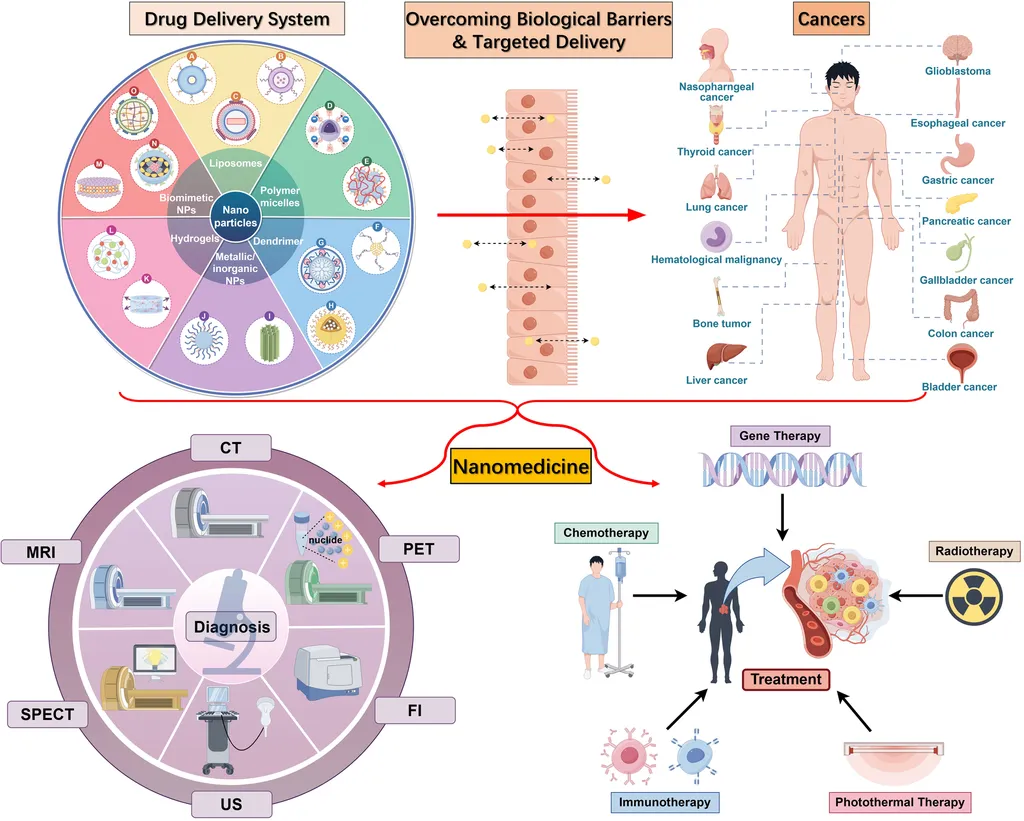
In a groundbreaking development that could revolutionize tumor treatment, researchers have engineered a novel nanomaterial that combines the powers of light and sound to combat cancer more effectively than ever before. Dr. Wei Wang, a leading scientist from the College of Materials and Chemical Engineering at China Three Gorges University, has spearheaded this innovative study, published in the journal *Biofunctional Materials* (which translates to *Bioactive Materials* in English).
The research introduces titanium-protoporphyrin coordinated nanoparticles (TiPPs), meticulously designed to harness the potential of both photodynamic therapy (PDT) and sonodynamic therapy (SDT). These therapies utilize light and ultrasound, respectively, to generate reactive oxygen species (ROS) that target and destroy tumor cells. “The key to our success lies in the rational selection of biocompatible materials and the precise engineering of these nanoparticles,” Dr. Wang explained.
The TiPPs, with a uniform size of approximately 70 nanometers, were created through a process called coordination self-assembly. This method ensures that the nanoparticles are not only effective but also safe for biological applications. When exposed to light or ultrasound for just six minutes, the TiPPs demonstrated remarkable ROS generation efficiency. The light group achieved a DPBF oxidation rate of 71.6%, while the ultrasound group reached 46.6%, underscoring their exceptional photo- and sono-responsive capabilities.
The real game-changer, however, is the combination of PDT and SDT. In vitro cytotoxicity assays and in vivo studies on tumor-bearing mice revealed that the dual-modal therapy significantly outperformed single-mode treatments. This synergistic approach opens new avenues for more effective and targeted cancer therapies, potentially reducing the need for invasive procedures and harsh chemicals.
The implications of this research extend beyond the medical field. The development of multifunctional nanomaterials like TiPPs could inspire innovations in other sectors, including energy. For instance, the principles of metal-organic coordination engineering could be applied to create more efficient and sustainable energy storage solutions. “This study not only establishes an efficient dual-modal synergistic therapeutic platform but also introduces an innovative paradigm for the development of multifunctional sensitizers,” Dr. Wang noted.
As the world continues to seek advanced solutions for complex challenges, the work of Dr. Wang and his team serves as a beacon of hope and a testament to the power of interdisciplinary research. The publication in *Biofunctional Materials* marks a significant milestone in the journey towards more effective cancer treatments and beyond, paving the way for future developments in nanotechnology and biomedicine.