
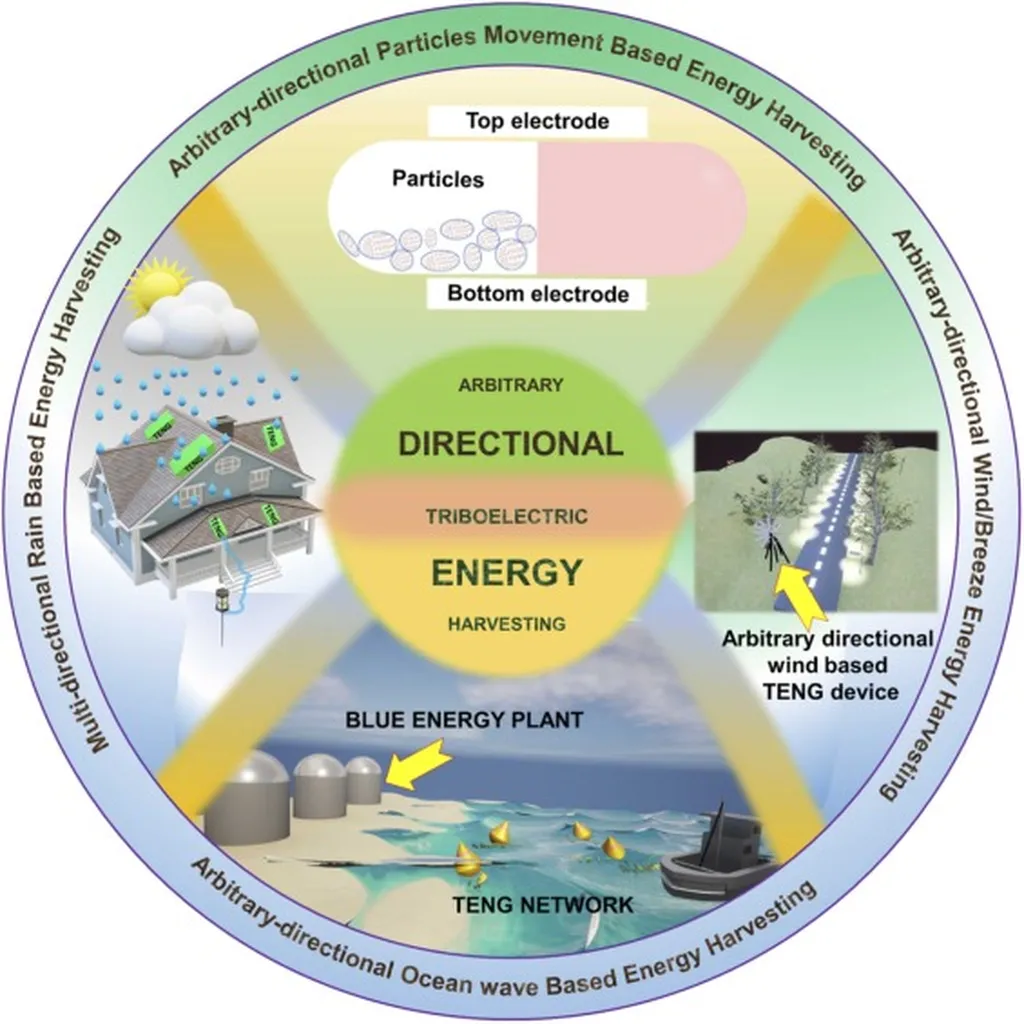
In the heart of China, researchers at Zhengzhou University are making waves in the energy sector with a technology that might just revolutionize how we harness power from our surroundings. Triboelectric nanogenerators, or TENGs, first introduced in 2012, have been steadily gaining traction, and now, a new review published in *Materials Futures* (translated to English as *Materials Horizons*) is shedding light on their potential to transform energy harvesting and sensing technologies.
At the forefront of this research is Xilong Kang, a professor at the School of Mechanical and Power Engineering at Zhengzhou University. Kang and his team have been exploring the remarkable capabilities of TENGs, which can convert mechanical energy into electrical energy through the triboelectric effect—a phenomenon where certain materials become electrically charged after they come into contact with another different material and then are separated.
“What sets TENGs apart is their ability to harvest energy from low-frequency, slow movements,” Kang explains. “This makes them incredibly versatile and useful in a wide range of applications, from industrial settings to environmental monitoring.”
One of the most promising areas for TENGs is in fluid energy harvesting, particularly in what’s known as “blue energy.” Traditional methods of harvesting energy from fluids, like water or air, often require high-speed flows. TENGs, however, can generate electricity even from slow, low-frequency fluid motion. This opens up new possibilities for distributed energy systems, where energy can be harvested from various sources in the environment.
“Imagine a world where every wave, every gust of wind, and every drop of rain could contribute to our energy needs,” Kang envisions. “TENGs bring us one step closer to that reality.”
But the applications of TENGs don’t stop at energy harvesting. Their high sensitivity and self-powered nature make them ideal for use in intelligent sensing systems. In the industrial Internet of Things (IIoT), for instance, TENG-based sensors could monitor equipment performance, predict maintenance needs, and improve overall efficiency.
Moreover, the high-voltage output of TENGs—reaching tens of kilovolts—opens up new avenues for high-voltage power sources and interface probe applications. These could be used in various fields, from medical devices to advanced materials science.
However, the path forward isn’t without its challenges. As Kang points out, “While the potential of TENGs is immense, there are still hurdles to overcome, such as improving their efficiency and durability, and integrating them into existing systems.”
Despite these challenges, the future of TENGs looks bright. With ongoing research and development, these remarkable devices could very well shape the future of the energy sector, making our world more sustainable and interconnected than ever before.
As Kang and his team continue to push the boundaries of what’s possible with TENGs, one thing is clear: the energy revolution is here, and it’s triboelectric.