
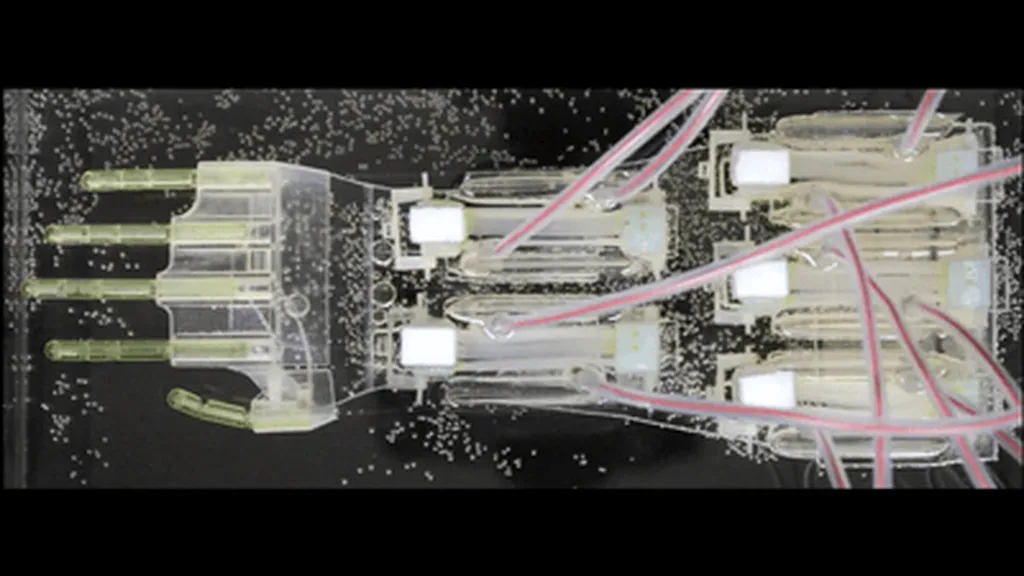
In a groundbreaking development that bridges the gap between biology and robotics, researchers have made significant strides in the field of biohybrid robots powered by muscle cells. This innovative fusion of biological tissue engineering and robotics holds immense potential for various biomedical applications, from drug delivery to regenerative medicine. The research, led by Niyou Wang from the Division of Engineering in Medicine at Brigham and Women’s Hospital and Harvard Medical School, in collaboration with the Institute of Materials Research and Engineering (IMRE) at A*STAR in Singapore, has been published in the *International Journal of Extreme Manufacturing*, which translates to the *Journal of Extreme Manufacturing Technology*.
Biohybrid robots represent a transformative approach to creating devices that can interact with biological systems in ways that traditional robots cannot. These robots are powered by living muscle cells, which enable controlled actuation and autonomous movement. The research categorizes current examples of biohybrid systems and explores advanced biofabrication techniques that drive their development. These techniques include 3D bioprinting, electrospinning, micro/nano patterning, self-assembly, and microfluidic devices. Each of these methods facilitates precise cell alignment, enhances electrical and mechanical properties, and enables the seamless integration of biological components with engineered structures.
“By incorporating both cardiomyocytes and skeletal muscle cells, we can achieve controlled actuation and adaptability to environmental stimuli,” explains Niyou Wang. This adaptability is crucial for applications such as targeted drug delivery, assistive devices, and fluid transport in engineered tissues. The integration of biological systems with robotic components advances regenerative medicine, disease modeling, drug screening, and soft robotics.
The research also addresses key challenges in biofabrication, such as scalability, biocompatibility, and functional integration. Optimization strategies are discussed to overcome these hurdles, paving the way for the next generation of biohybrid robotic systems. For instance, biohybrid robots like swimmers, actuators, and pumps can be used for targeted drug delivery, assistive devices, and fluid transport in engineered tissues.
The implications of this research extend beyond the biomedical field. In the energy sector, biohybrid robots could revolutionize the way we approach energy storage and conversion. Imagine biohybrid systems that can self-repair or adapt to changing environmental conditions, enhancing the efficiency and longevity of energy storage devices. This could lead to more sustainable and reliable energy solutions, addressing some of the critical challenges faced by the energy sector today.
As we look to the future, the potential for biohybrid robots is vast. The research published in the *Journal of Extreme Manufacturing Technology* provides a comprehensive perspective on the state-of-the-art advancements and potential optimizations in biofabrication techniques. This work not only advances our understanding of biohybrid systems but also opens up new avenues for innovation and discovery. The fusion of biology and robotics is set to redefine the boundaries of what is possible, shaping the future of biomedical applications and beyond.