
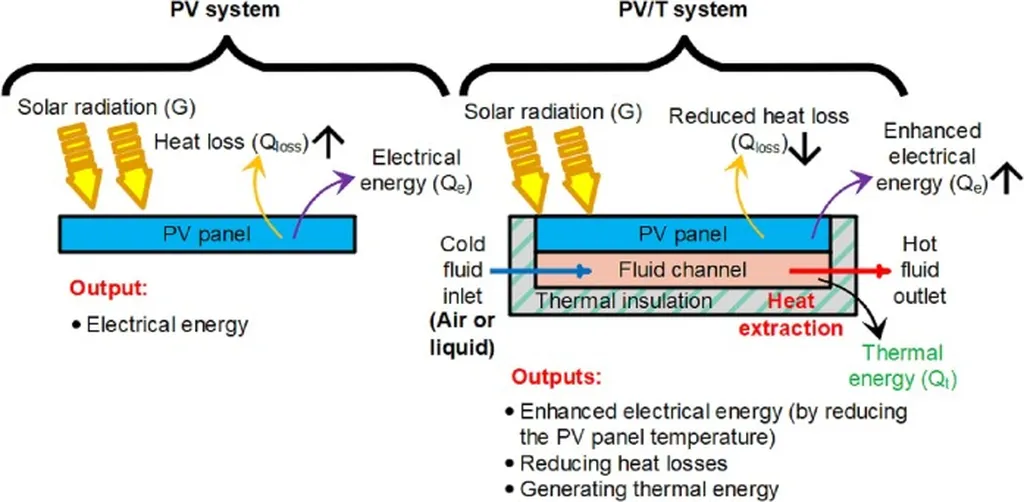
In the quest to balance energy consumption with environmental sustainability, a groundbreaking study led by Tianchi Wang from the Faculty of Architecture and Civil Engineering at Huaiyin Institute of Technology in China is paving the way for innovative building designs. The research, published in the *International Journal of Renewable Energy Development* (translated as *Journal of Renewable Energy Development*), focuses on integrated photovoltaic/thermal (PV/T) building systems, offering a promising solution to reduce dependence on traditional energy sources and cut building energy consumption.
The study addresses a critical issue in current solar energy systems: the improper placement of photovoltaic solar thermal collectors often hampers the maximum energy conversion efficiency. To tackle this, Wang and his team designed an integrated PV/T building system optimized for different light resources and environmental conditions. The results are impressive. The system achieved zero energy operation during winter, with a total energy consumption of 798.92kW·h. Throughout the winter, the system generated a cumulative power supply of 214.63kW·h and heat generation of 79.68kW·h.
One of the standout features of this research is the use of solar photovoltaic solar thermal collectors to replace traditional roof coverings or insulation layers. This not only reduces the impact of solar energy on buildings but also avoids duplicate investments, cutting costs significantly. “This approach enhances resource utilization efficiency and reduces environmental pollution,” Wang explains, highlighting the dual benefits of cost savings and environmental stewardship.
The implications for the energy sector are substantial. As buildings account for a significant portion of global energy consumption, integrating PV/T systems into building designs can drastically reduce energy demand and promote sustainable development. The study’s findings suggest that such systems can meet heating needs while improving power generation efficiency, a win-win for both building owners and the environment.
Wang’s research is a testament to the potential of intelligent building design in the green energy transition. By optimizing the placement and utilization of solar energy systems, the construction industry can move towards more sustainable practices. “This study can improve power generation efficiency, meet heating needs, enhance resource utilization efficiency, reduce environmental pollution, and promote the sustainable development of the construction industry,” Wang asserts.
As the world grapples with the challenges of climate change and energy sustainability, innovations like Wang’s integrated PV/T building system offer a beacon of hope. The research not only provides a practical solution for reducing energy consumption but also sets a precedent for future developments in the field. With further advancements and widespread adoption, such systems could revolutionize the way we design and power our buildings, shaping a greener and more sustainable future.