
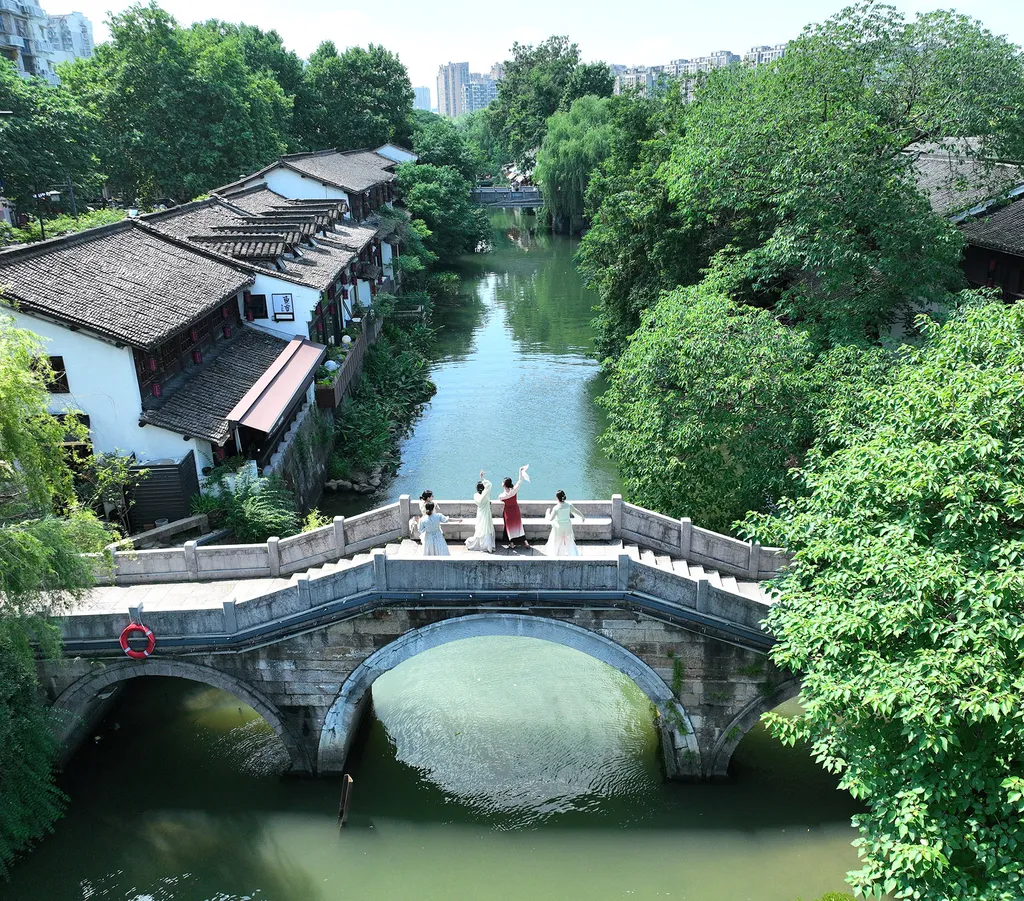
In the heart of Shandong Province, China, a groundbreaking study is reshaping how urban planners approach public space design, and the secret lies in the power of machine learning. Jing Zhao, a researcher from the School of Civil Engineering and Architecture at the University of Jinan, has been delving into the intricate behaviors and preferences of residents along the historic Grand Canal. Her work, recently published in *Frontiers in Built Environment* (which translates to “Frontiers in the Built Environment”), is not just about understanding people; it’s about transforming cities into more livable, sustainable spaces.
Zhao’s research is a beacon of innovation in urban planning. By leveraging machine learning techniques like K-means clustering, association rule mining, and correlation analysis, she has uncovered distinct groups of residents with varying preferences for public spaces. “Traditional planning methods often fall short in capturing the detailed behaviors of residents,” Zhao explains. “Our study demonstrates that machine learning can effectively identify and quantify key factors influencing public space use, providing more accurate policy recommendations for urban planners.”
The study surveyed 1,008 respondents across four cities, revealing three distinct groups: young and middle-aged locals who prioritize accessibility, middle-aged and elderly residents keen on cultural engagement, and diverse transportation users with mixed spatial preferences. Association rule mining uncovered strong correlations between location types and perceived attributes like cleanliness and aesthetics. Correlation analysis further highlighted statistically significant positive correlations between aesthetics and cleanliness, as well as between safety and cleanliness.
The implications for urban planning are profound. Zhao’s findings offer valuable data-driven insights that can guide the optimization of facility layouts for specific groups. For instance, adding canal cultural display nodes for culturally engaged groups and improving barrier-free facilities for those with high accessibility needs can enhance the inclusiveness and utilization efficiency of public spaces.
This research is not just about creating better parks or plazas; it’s about fostering more vibrant, sustainable communities. As cities continue to grow and evolve, the need for data-driven planning becomes increasingly critical. Zhao’s work sets a precedent for how machine learning can be empirically applied to public space planning, ensuring that urban environments better meet the needs of diverse populations.
For the energy sector, the commercial impacts are significant. As urban areas become more efficient and livable, the demand for sustainable energy solutions grows. Smart cities, equipped with data-driven planning tools, can optimize energy use, reduce waste, and create more resilient infrastructure. Zhao’s research is a stepping stone towards this future, demonstrating the power of machine learning in shaping the cities of tomorrow.
In a world where urbanization is accelerating, Zhao’s work offers a glimpse into a future where technology and planning converge to create spaces that are not just functional but truly enriching. As she puts it, “This research provides a foundation for more inclusive and efficient public space planning, ensuring that our cities are not just places to live, but places to thrive.”