
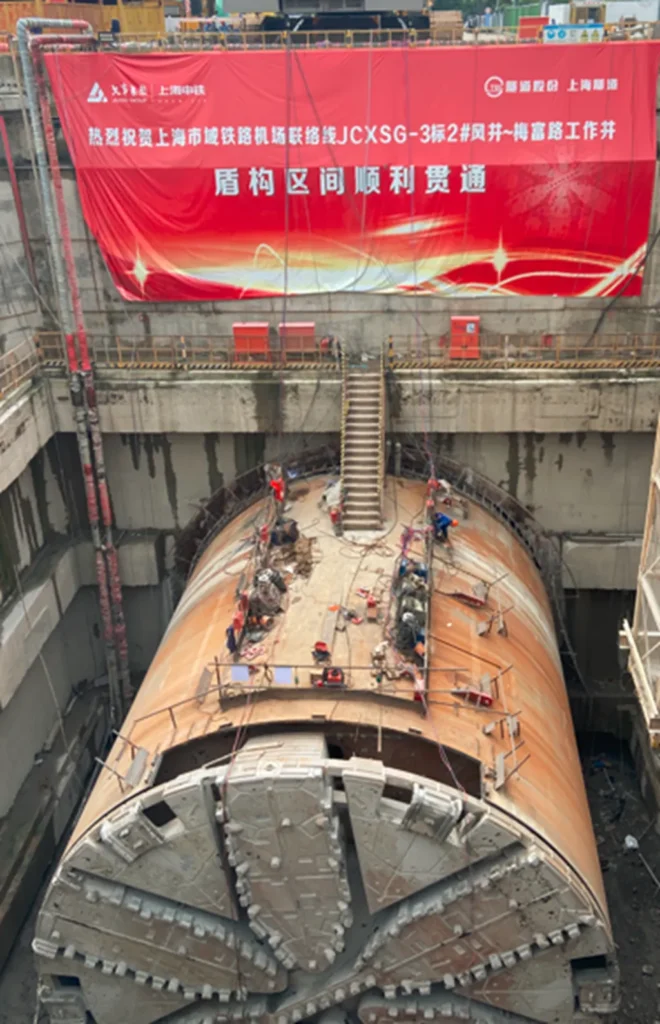
In the heart of Shanghai, a monumental feat of engineering is unfolding beneath the bustling Pudong International Airport. A team led by DU Feng of Shanghai Shen-Tie Investment Co., Ltd. is pioneering a groundbreaking project: the Shanghai Suburban Railway Airport Link Line, a shield tunnel that snakes beneath airport facilities and taxiways, setting new standards for ultra-deep, high-pressure tunneling in sandy strata.
The project, detailed in a recent study published in ‘Chengshi guidao jiaotong yanjiu’ (translated as ‘Urban Rail Transit Research’), is a testament to human ingenuity and technological advancement. The tunnel, with an outer diameter of just 9 meters, plunges to a maximum depth of 52 meters, traversing approximately 1.9 kilometers entirely within the challenging ⑦2 silty sand stratum.
DU Feng and his team faced a formidable challenge: the high design difficulties and construction risks associated with ultra-deep burial, high water pressure, and long-distance sandy strata. “The lack of reference projects or construction experiences made this a pioneering endeavor,” DU Feng explained. To mitigate these risks, the team employed air-cushion slurry balance shield machines, enhancing the main drive and shield tail seal designs to ensure robust pressure-bearing capacities.
One of the critical innovations was the use of water pressure resistance tests on elastic sealing gaskets of different shapes to determine the most appropriate cross-sectional parameters. During shield advancement, the team meticulously controlled the synchronous grouting amount and shield tail grease injection volume to ensure optimal shield tail sealing performance.
The team also analyzed variations in shield thrust and cutterhead torque, tailoring their approach to the differing strata encountered. By radially injecting thixotropic slurry using the shield machine, they optimized excavation parameters and reduced cutter wear, a significant advancement in tunneling technology.
The results speak for themselves: no leakage occurred at either the shield tail or segment joints during the tunneling process. Moreover, the maximum settlement values of the taxiways caused by the engineering were all less than 7 mm, meeting the stringent settlement control requirements.
This project is not just a local marvel but a global benchmark. The technologies and methodologies developed by DU Feng and his team could revolutionize the construction of similar projects worldwide, particularly in urban areas with complex geological conditions. The commercial implications for the energy sector are substantial, as these advancements could facilitate the construction of underground energy infrastructure, such as pipelines and storage facilities, in previously inaccessible locations.
As the Shanghai Suburban Railway Airport Link Line nears completion, it stands as a testament to human ingenuity and the power of innovative engineering. The lessons learned and technologies developed here will undoubtedly shape the future of tunneling and construction, paving the way for safer, more efficient, and more ambitious projects in the years to come.