
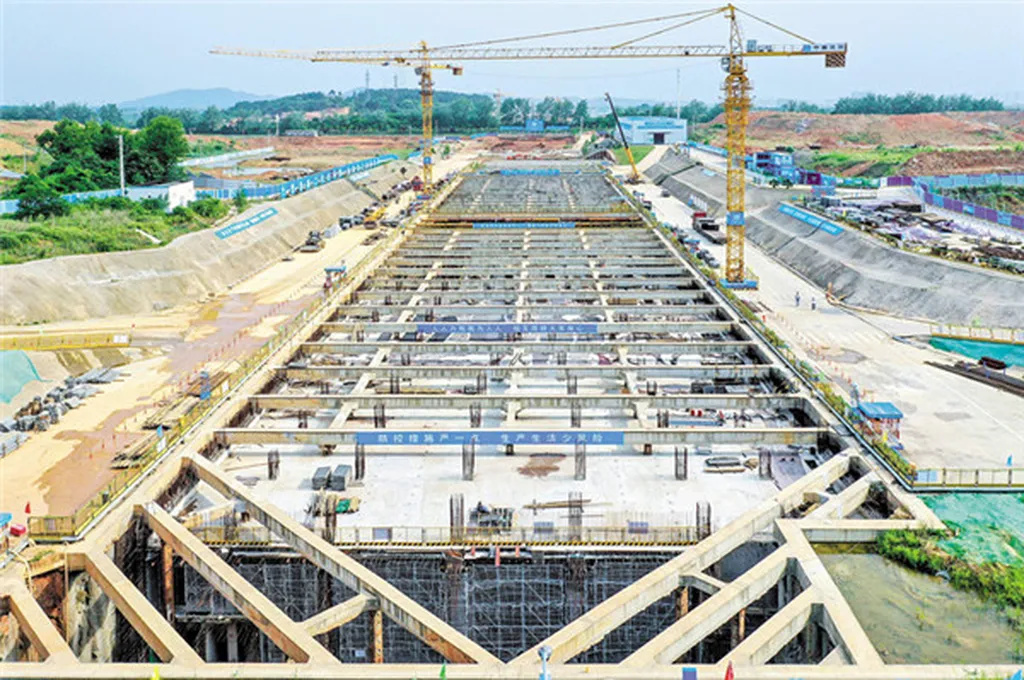
In the heart of China’s bustling urban development, a groundbreaking study is set to revolutionize the way underground stations are constructed. Researchers from the China Railway Fourth Survey and Design Institute Group Co., Ltd. in Wuhan have delved into the mechanical performance of auxiliary interface framework structures in prefabricated underground stations, potentially paving the way for faster, more efficient, and safer construction methods.
The study, led by MAO Lianggen, focuses on the critical joints of these framework structures, which are essential for the assembly rate of underground stations. “Understanding the mechanical behaviors of these structures is crucial for improving the assembly rate and overall construction efficiency,” MAO explains. The research involved a 1:2 scaled experimental test on the joints, providing valuable insights into their performance under load.
One of the key findings was the appearance of diagonal cracks at the ends of steel-concrete beams in entrance/exit frameworks during the loading process. These cracks weakened the concrete confinement of the top reinforcement, leading to bond failure and cracking at the reinforcement ends. This phenomenon significantly affects the ultimate bearing capacity of the specimens, highlighting the need for careful design and material selection.
The study also revealed that the internal force transfer between the interface framework structure and the main structure remained consistently reliable throughout the loading process. This finding is a testament to the robustness of the design and its potential for widespread application in the construction industry.
To validate their experimental results, the researchers conducted a finite element analysis using Abaqus software. The established model accurately reflected the bearing capacity, deformation characteristics, and crack propagation law of the specimen, proving its applicability for further research.
The implications of this study are far-reaching, particularly for the energy sector. As cities continue to expand and the demand for efficient public transportation grows, the need for faster and more cost-effective construction methods becomes increasingly apparent. Prefabricated underground stations offer a promising solution, and this research brings us one step closer to realizing their full potential.
“Our findings contribute to improving the assembly rate of underground stations, shortening construction periods, enhancing labor productivity, and promoting the transformation and upgrade of the construction industry,” MAO asserts. This research, published in the journal ‘Chengshi guidao jiaotong yanjiu’ (Urban Rapid Rail Transit), is a significant step forward in the quest for more efficient and sustainable urban infrastructure.
As we look to the future, the insights gained from this study will undoubtedly shape the development of prefabricated underground stations, making them a more viable and attractive option for urban planners and construction companies alike. The energy sector, in particular, stands to benefit from these advancements, as the demand for efficient and sustainable transportation solutions continues to grow.