
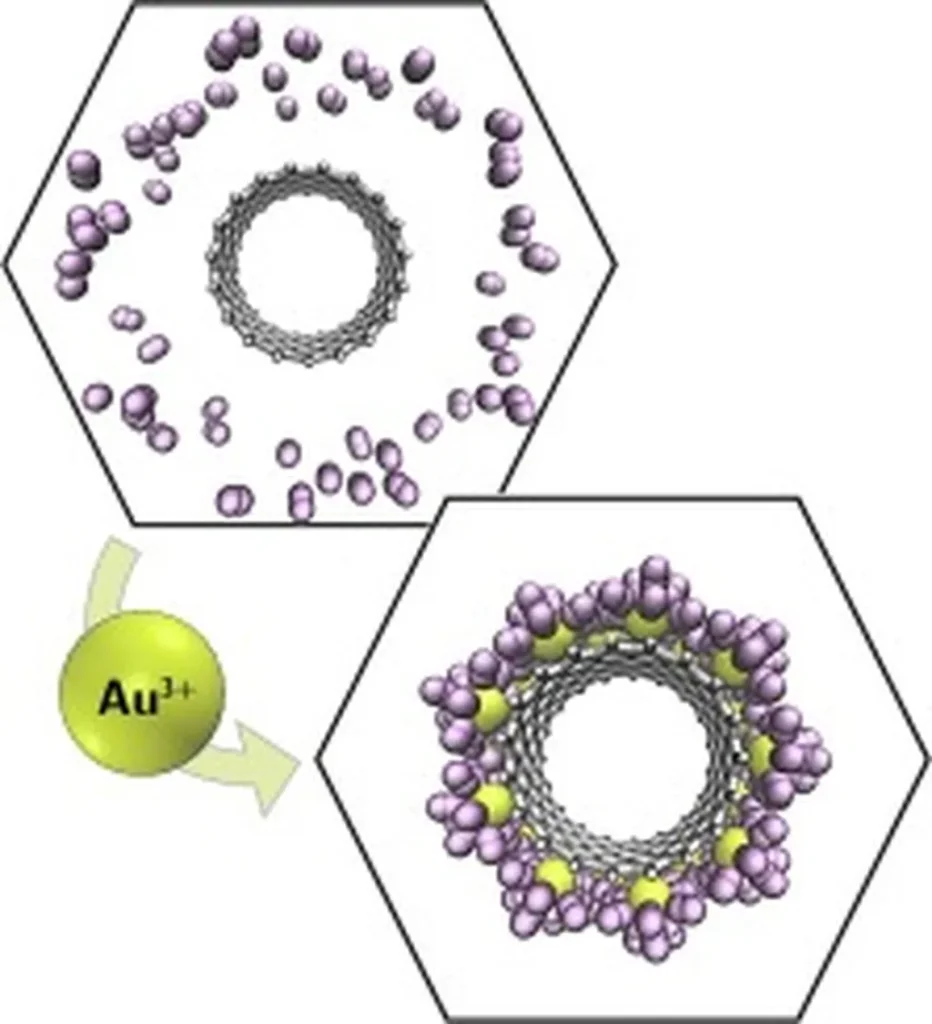
In a groundbreaking study published in the journal Materials Open, researchers have uncovered a novel approach to manipulating the magnetic properties of silicon carbide nanotubes, potentially opening doors to innovative applications in the energy sector. The research, led by Vusala Nabi Jafarova from Azerbaijan State Oil and Industry University, focuses on the intriguing behavior of gold-doped silicon carbide nanotubes and their potential use in spintronic and nanoscale magnetic devices.
The study reveals that by doping single-walled (6,0) silicon carbide nanotubes with gold, the electronic structure of the nanotubes is significantly altered. This modification induces a half-metallic behavior, where the majority spin channel becomes semiconducting with a band gap of approximately 0.8 eV, while the minority spin channel remains metallic. “This unique electronic structure is a result of the hybridization between carbon 2p orbitals and gold 4d orbitals near the Fermi level,” explains Jafarova.
The implications of this discovery are profound for the energy sector. Spintronic devices, which exploit the spin of electrons rather than their charge, could lead to more efficient and powerful electronic devices. “The stable magnetic ordering and thermodynamic stability of these gold-doped nanotubes make them promising candidates for spintronic applications,” says Jafarova.
Moreover, the study found that the net magnetic moment primarily arises from three carbon atoms chemically bonded to the gold dopant. This localized magnetic behavior could be harnessed for nanoscale magnetic devices, offering new possibilities for data storage and processing.
The research also highlights the potential for these materials to be used in the energy sector, particularly in the development of more efficient and compact electronic devices. “The unique properties of these nanotubes could lead to breakthroughs in energy storage and conversion technologies,” Jafarova adds.
The study, published in Materials Open (translated to English as “Materials Open Access”), underscores the importance of fundamental research in driving technological advancements. As the world seeks sustainable and efficient energy solutions, the insights gained from this research could pave the way for innovative applications in the energy sector.
This research not only advances our understanding of the magnetic properties of silicon carbide nanotubes but also opens up new avenues for their practical applications. As we continue to explore the potential of nanomaterials, studies like this one will be crucial in shaping the future of energy technology.