
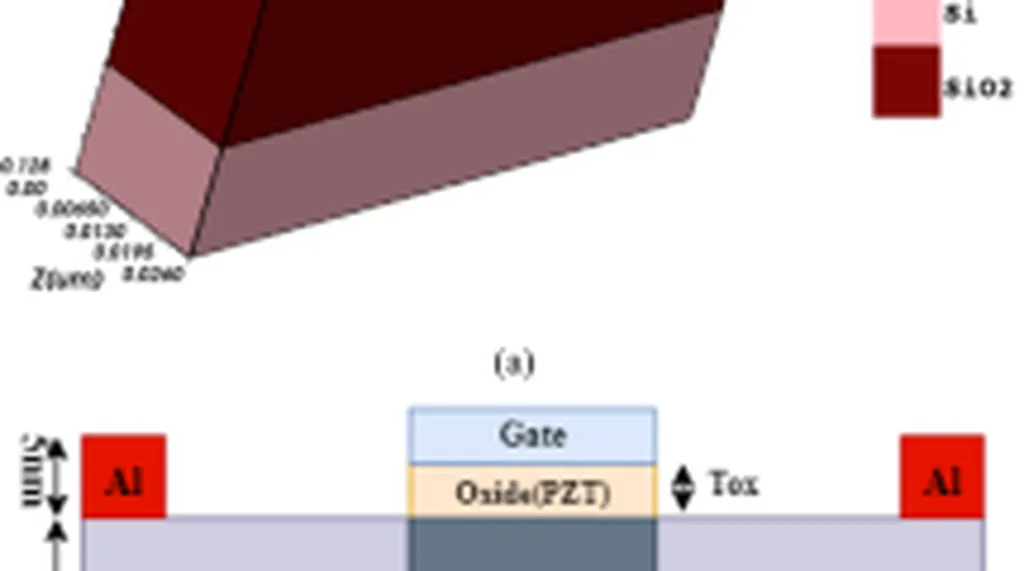
In the relentless pursuit of smaller, faster, and more energy-efficient transistors, researchers have turned to innovative materials and designs to push the boundaries of semiconductor technology. A recent study published in the journal ‘Discover Materials’ (translated from Russian as ‘Find Materials’), led by Suman Lata Tripathi from the Department of Electronics and Telecommunication at Symbiosis Institute of Technology, Symbiosis International (Deemed University), presents a promising advancement in this arena. The research focuses on the design of a 30-nanometer negative capacitance FinFET (NC-FinFET) using PZT (lead zirconate titanate) for high-speed, low-power processors.
FinFETs, or Fin Field-Effect Transistors, have been at the forefront of semiconductor technology due to their superior gate control over the channel, enabling better performance at reduced dimensions. However, as technology nodes shrink below 30 nanometers, conventional FinFETs face challenges in maintaining optimal performance. Tripathi’s research explores the use of ferroelectric materials with negative capacitance properties to enhance FinFET performance.
“Ferroelectric materials exhibit unique properties that can significantly improve the subthreshold performance of FinFETs,” explains Tripathi. “By integrating PZT near its morphotropic phase boundary, we can achieve a steep subthreshold slope and an enhanced ON/OFF current ratio, which are crucial for low-power applications.”
The study demonstrates that the proposed NC-FinFET design achieves a reduced subthreshold slope of 60.17 mV/dec, a higher Ion/Ioff ratio of 10¹⁰, and lower static power consumption (~0.0003 nW). These improvements are attributed to the sharp variations in electric field and surface potential enabled by the ferroelectric material. The research also analyzes the impact of doping variations and gate materials on the device’s performance.
The implications of this research are significant for the energy sector, particularly in the development of high-speed, low-power processors. As the demand for energy-efficient computing continues to grow, innovations in semiconductor technology are crucial. The NC-FinFET design proposed by Tripathi and her team could pave the way for more efficient processors, reducing energy consumption and improving performance in various applications, from data centers to mobile devices.
“This research opens up new possibilities for the design of next-generation transistors,” says Tripathi. “The integration of ferroelectric materials like PZT can lead to significant improvements in performance and energy efficiency, addressing the growing demands of the semiconductor industry.”
As the field of semiconductor technology continues to evolve, the work of Tripathi and her team highlights the importance of exploring novel materials and designs. The study, published in ‘Discover Materials’, not only advances our understanding of NC-FinFETs but also sets the stage for future developments in high-speed, low-power processors, shaping the future of computing and energy efficiency.