
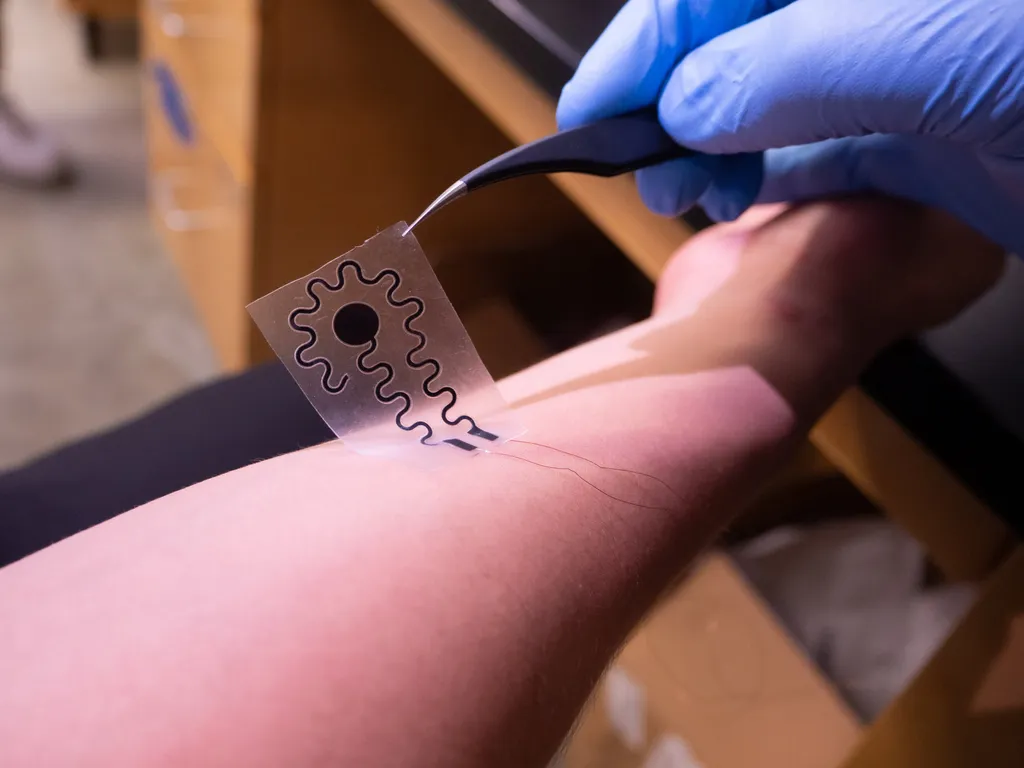
In the realm of wearable technology and advanced medical applications, a groundbreaking development has emerged from the labs of the Guangdong Technion-Israel Institute of Technology in Shantou, China. Researchers, led by Qingyuan Sun, have introduced a novel type of stretchable, moisture-permeable on-skin electrode that promises to revolutionize long-term electrophysiological monitoring. This innovation, detailed in a recent study published in *InfoMat* (translated from Chinese as “Information Materials”), addresses critical limitations in current wearable electronics, paving the way for more durable, comfortable, and efficient devices.
The study focuses on the challenges faced by conventional stretchable devices, which often suffer from poor stretchability, limited permeability, and mechanical mismatches between substrates and conductors. These issues lead to reduced durability and inconsistent conductivity, hindering their application in fields such as advanced medical therapy, wearable electronics, soft robotics, and human-machine interaction.
To overcome these hurdles, Sun and his team devised a liquid metal-based flexible conductor using an innovative direct coating method. This conductor is supported by an electrospun fiber nanomesh, which undergoes a pre-stretch activation process to enhance permeability. The result is an electrode with remarkable properties: it boasts an electrical conductivity of 3730 S/cm, a water vapor transmission rate of 40.2 g/m²h, and stretchability exceeding 2000% strain. Moreover, the electrode demonstrates exceptional mechanical durability, making it ideal for long-term health monitoring applications.
“The key innovation here is the combination of liquid metal with a fiber mat structure,” explained Sun. “This not only enhances the electrode’s stretchability and permeability but also ensures stable electrical performance under sustained or intense stretching.”
The implications of this research are vast, particularly in the energy sector. As wearable technology becomes increasingly integrated into daily life, the need for efficient, long-lasting, and comfortable devices grows. The liquid metal fiber mat structure allows for the creation of breathable, on-skin electronics capable of continuous health monitoring, which can be crucial for applications in energy management and health monitoring for workers in demanding environments.
“This technology could be a game-changer for industries requiring precise, long-term monitoring of physiological data,” Sun added. “Its durability and comfort make it suitable for a wide range of applications, from medical monitoring to industrial safety.”
The study’s findings highlight the potential for future developments in wearable electronics, particularly in creating devices that are not only highly functional but also comfortable and durable. As the demand for advanced health monitoring solutions continues to rise, innovations like this could play a pivotal role in shaping the future of the energy sector and beyond.
With the publication of this research in *InfoMat*, the scientific community now has a clearer path forward in developing next-generation wearable technologies that are both highly efficient and user-friendly. The work of Qingyuan Sun and his team at the Guangdong Technion-Israel Institute of Technology represents a significant step towards achieving these goals, offering a glimpse into a future where technology seamlessly integrates with the human body for enhanced health and safety.