
In a groundbreaking study published in the journal *Applied Rheology* (translated from Chinese as “应用流变学”), researchers have delved into the intricate behavior of hybrid nanofluids, unlocking potential advancements for the energy sector. Lead author Arafat Hussain, affiliated with the College of Mathematics and System Sciences at Xinjiang University in Urumqi, China, has explored the dynamics of magneto carboxymethylcellulose (CMC)–water-based hybrid nanofluids containing molybdenum disulfide (MoS2) and zinc oxide (ZnO) nanoparticles. This research could pave the way for more efficient thermal management systems, impacting everything from industrial processes to renewable energy technologies.
The study focuses on the flow of these hybrid nanofluids through a porous surface, a scenario with significant implications for heat exchange systems. “Understanding the behavior of these fluids under various conditions is crucial for optimizing thermal performance,” Hussain explains. The research employs advanced mathematical modeling and simulation techniques, utilizing the Laplace transformation method to solve complex differential equations. This approach provides a detailed analysis of how factors such as thermal radiation, heat generation, and chemical reactions influence the flow dynamics.
One of the key findings is that the presence of a magnetic field and increased porosity can significantly reduce the velocity distribution of the nanofluid. “This insight is particularly valuable for designing systems where precise control of fluid flow is essential,” Hussain notes. Additionally, the study reveals that thermal radiation enhances temperature distribution, while the Prandtl number—a dimensionless number representing the ratio of momentum diffusivity to thermal diffusivity—has the opposite effect.
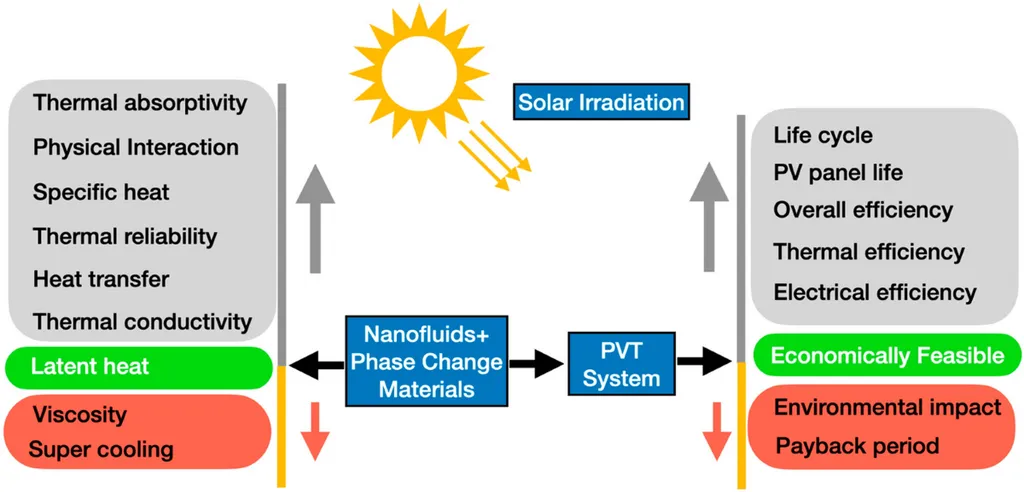
The implications for the energy sector are profound. Efficient thermal management is critical for improving the performance and longevity of various energy systems, from solar panels to nuclear reactors. By optimizing the flow of hybrid nanofluids, engineers can enhance heat transfer processes, leading to more efficient energy conversion and storage. “This research provides a foundation for developing next-generation thermal management solutions that are both efficient and cost-effective,” Hussain adds.
The study also highlights the importance of understanding the interplay between different variables, such as the Schmidt number, which affects the concentration of species in the fluid. This knowledge can be leveraged to design systems that minimize energy losses and maximize efficiency. As the world continues to seek sustainable energy solutions, the insights gained from this research could play a pivotal role in shaping the future of the energy sector.
In summary, Hussain’s work represents a significant step forward in the field of fluid dynamics and thermal engineering. By unraveling the complexities of hybrid nanofluid behavior, this research opens up new possibilities for innovation and improvement in energy technologies. As the energy sector continues to evolve, the findings from this study will undoubtedly contribute to the development of more efficient and sustainable systems.