
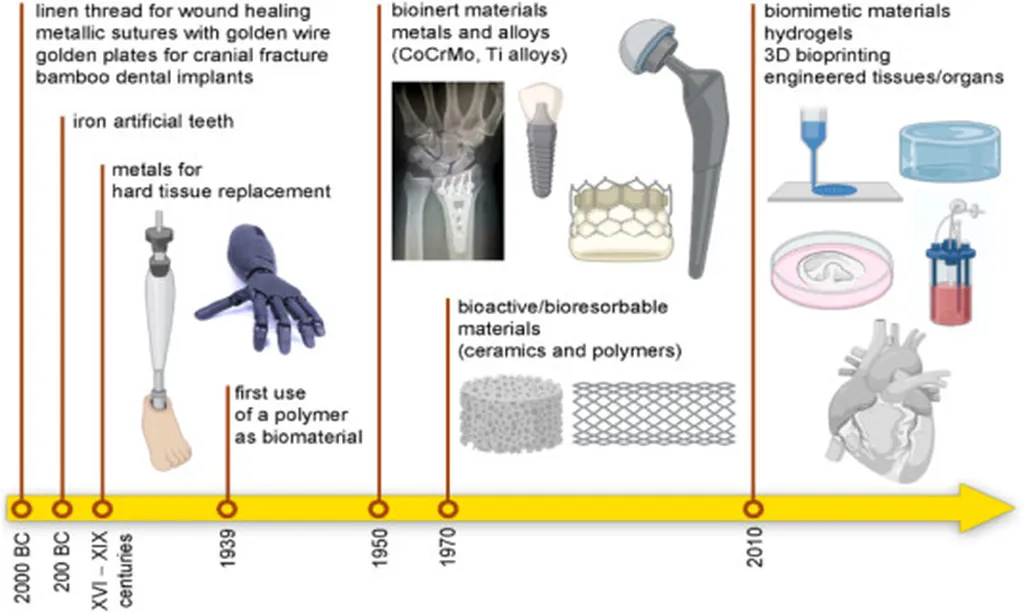
In a significant stride towards enhancing biomaterial properties, researchers from the Taras Shevchenko National University of Kyiv have developed novel composites that could revolutionize orthopedic applications. The study, led by Dr. Nataliia Strutynska, focuses on calcium phosphates modified with sodium, magnesium, and borate anions, combined with zirconium dioxide (ZrO2) to create composites with improved microhardness and antibacterial activity.
The research, published in the journal “Materials Research Express” (which translates to “Expressions of Materials Research”), demonstrates that the incorporation of these elements into the calcium phosphate structure leads to a notable increase in hardness. Specifically, the microVickers hardness tests revealed a two-fold increase in hardness from 39.2HV to 74.7HV when 25wt% of ZrO2 was added to the composite.
“This significant enhancement in hardness is a crucial step forward in developing biomaterials that can withstand the mechanical demands of orthopedic implants,” said Dr. Strutynska.
The study also highlights the antibacterial properties of these composites. The addition of just 5 mM of a composite based on Ca9.625Na0.25Mg0.25(PO4)6(OH)2 with 5 wt% ZrO2 resulted in an 11.3-fold and 10.9-fold inhibition of strains S. aureus and P. aeruginosa growth, respectively. Even more impressive, the highest antibacterial activity was observed with a 100-fold decrease in S. aureus viability when 20 mM of Ca9.625Na0.25Mg0.25(PO4)5.5(BO3)0.5(BO2)2 was added.
The implications of this research are vast, particularly in the field of orthopedic implants where durability and infection resistance are paramount. “The potential to create biomaterials that are not only stronger but also inherently resistant to bacterial infections could significantly improve patient outcomes and reduce the need for revision surgeries,” Dr. Strutynska added.
The findings pave the way for further cytotoxicity and biocompatibility tests, which are essential for evaluating the safety and effectiveness of these composites in clinical applications. As the demand for advanced biomaterials continues to grow, this research offers a promising avenue for innovation in the medical and energy sectors, where similar materials could be utilized for various applications.
This breakthrough underscores the importance of interdisciplinary research in driving technological advancements. The study’s results, published in “Materials Research Express,” provide a solid foundation for future developments in the field of biomaterials and beyond.