
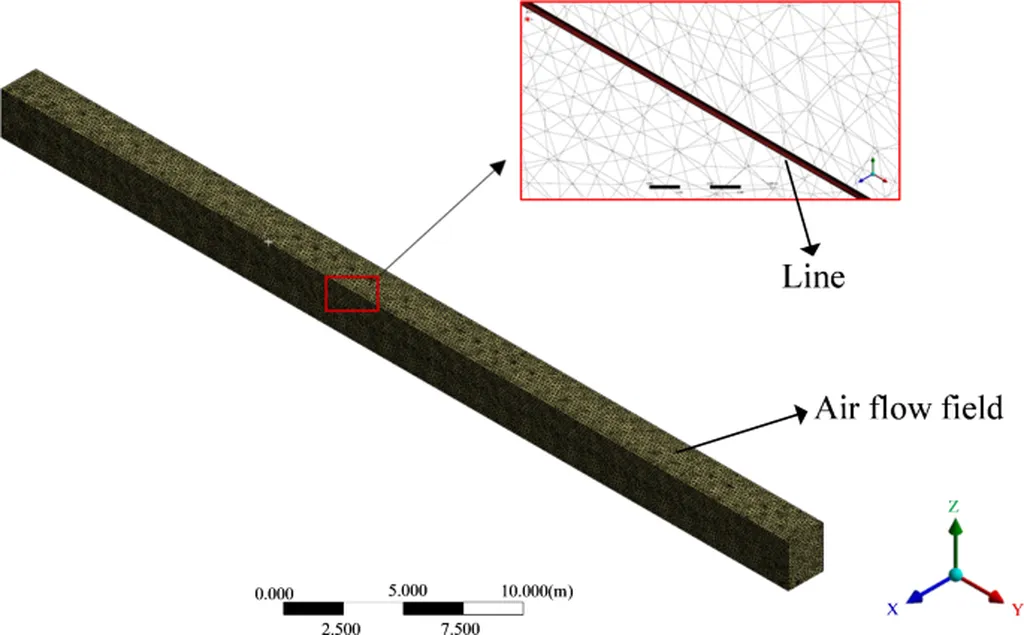
In the quest to enhance the reliability and efficiency of power transmission systems, researchers have turned to advanced modeling techniques to better understand and mitigate the dynamic behaviors of transmission conductors. A recent study published in the journal *Computer Assisted Methods in Engineering and Science* (translated from Chinese as “计算机辅助工程科学方法”) introduces a novel approach to analyzing galloping, a wind-induced vibration that can lead to significant operational challenges and potential failures in power lines.
Galloping, characterized by large-amplitude oscillations, poses a substantial risk to the integrity of transmission conductors. These vibrations, driven by wind forces, can cause conductors to swing violently, leading to potential collisions with nearby structures or even snapping. The phenomenon is particularly problematic in regions with frequent high winds, where the dynamic stresses on conductors can be severe.
The research, led by Hui Xiong from the College of Civil Engineering at Chongqing University and the Key Laboratory of New Technology for Construction of Cities in Mountain Area Chongqing, employs the Cosserat rod model to simulate the complex motions of transmission conductors. This model provides a robust framework for capturing the non-linear coupling between torsional and translational motions, which are key factors in galloping.
“Traditional models often oversimplify the dynamics of conductors, leading to inaccurate predictions of galloping behavior,” Xiong explains. “By using the Cosserat rod model, we can more accurately describe the large motions and deformations that occur during galloping, providing a more reliable basis for mitigation strategies.”
The study’s findings have significant implications for the energy sector. Accurate modeling of conductor dynamics can lead to better-designed transmission lines that are more resistant to galloping. This, in turn, can reduce maintenance costs, minimize downtime, and enhance the overall reliability of power transmission systems.
“Understanding the dynamics of galloping is crucial for developing effective countermeasures,” says Xiong. “Our research provides a valuable tool for engineers and researchers to better predict and manage these vibrations, ultimately improving the safety and efficiency of power transmission networks.”
The application of the Cosserat rod model represents a significant advancement in the field of transmission line dynamics. By offering a more comprehensive understanding of conductor behavior under wind forces, this research paves the way for innovative solutions that can enhance the resilience of power infrastructure.
As the energy sector continues to evolve, the need for robust and reliable transmission systems becomes increasingly critical. The insights gained from this study could shape future developments in conductor design and maintenance, ensuring that power transmission networks remain resilient in the face of dynamic environmental challenges.
For professionals in the energy sector, this research highlights the importance of advanced modeling techniques in addressing complex engineering problems. By leveraging the Cosserat rod model, engineers can develop more effective strategies to mitigate galloping and other dynamic phenomena, ultimately contributing to a more stable and efficient power grid.