
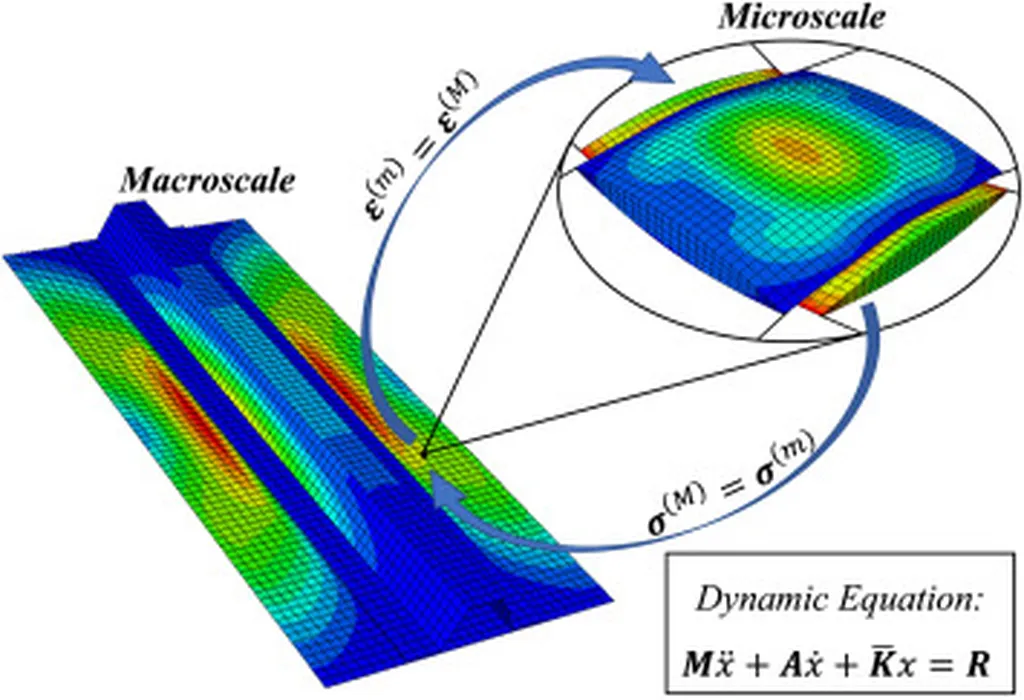
In the ever-evolving landscape of materials science and engineering, a groundbreaking study led by Adnan Ibrahimbegovic from Ecole Normale Superieure in Cachan, France, is set to redefine our understanding of material failure. Published in the esteemed journal *Computer Assisted Methods in Engineering and Science* (translated to English as *Computer-Aided Methods in Engineering and Science*), this research delves into the intricate world of probabilistic multiscale analysis, offering a fresh perspective on inelastic localized failure in solid mechanics.
At the heart of this study lies the quest to quantify uncertainty in the nonlinear response of heterogeneous materials, such as cement-based composites. Ibrahimbegovic and his team have pioneered two distinct approaches to tackle this challenge. The first approach involves constructing localized failure models with random fields as parameters of the failure criterion. The second approach focuses on Bayesian updates of the corresponding evolution equation. “The first approach is more suitable for the general case where the loading program is not known,” Ibrahimbegovic explains, “whereas the second approach is more suitable for the case where the loading program is prescribed.”
The implications of this research are far-reaching, particularly for the energy sector. Understanding and predicting material failure with greater accuracy can lead to significant advancements in the design and maintenance of energy infrastructure. From oil and gas pipelines to wind turbines and nuclear reactors, the ability to anticipate and mitigate failure can enhance safety, reduce costs, and improve efficiency.
One of the most compelling aspects of this study is its potential to bridge the gap between continuum damage mechanics and linear fracture mechanics. By providing a probability-based interpretation of the size effect, the models developed by Ibrahimbegovic and his team offer a more realistic prediction of localized failure phenomena. This could revolutionize the way engineers approach material design and failure analysis, leading to more robust and reliable structures.
The study also highlights the importance of microstructure approximation with a structured mesh and the use of random field Karhunen-Loève Eigenvalue (KLE) representation. These technical advancements not only enhance the accuracy of failure predictions but also pave the way for more sophisticated computational models in the future.
As the energy sector continues to evolve, the need for innovative solutions to material failure becomes increasingly critical. The research led by Adnan Ibrahimbegovic offers a promising path forward, combining probabilistic analysis with multiscale modeling to provide a comprehensive understanding of material behavior. This work not only advances the field of materials science but also holds significant commercial potential for the energy industry, driving progress and innovation in a sector that is vital to global economic and environmental sustainability.