
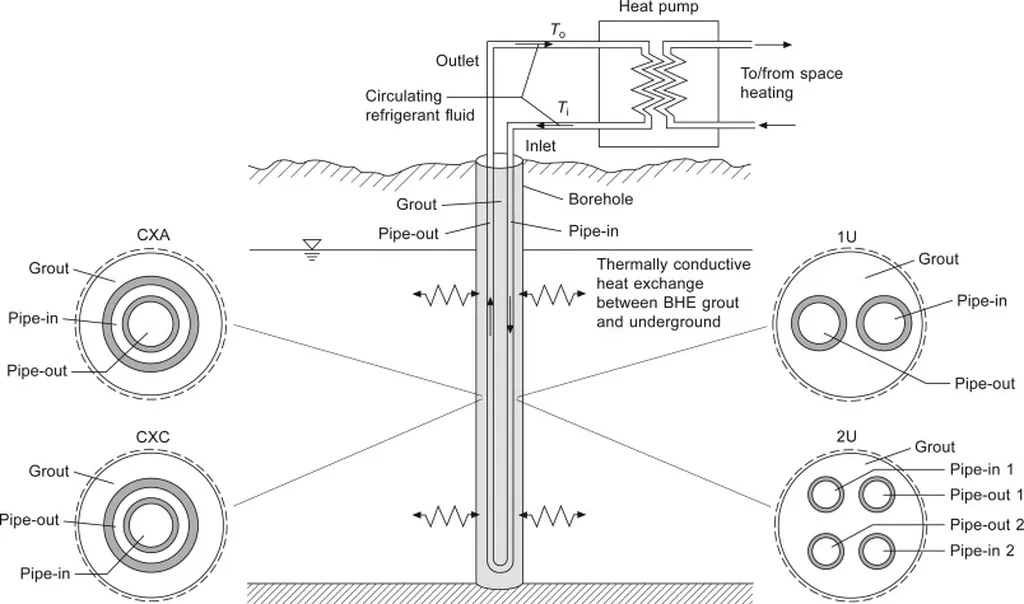
In the quest for sustainable and efficient energy solutions, a recent study published in *Computer Assisted Methods in Engineering and Science* (translated from Polish as *Komputerowe Metody w Inżynierii i Naukach*) sheds light on the long-term performance of borehole heat exchangers (BHE), a critical component of ground source heat pump (GSHP) systems. Led by Marek Jaszczur from the AGH University of Science and Technology in Kraków, the research delves into the intricate factors that influence the economic viability and efficiency of these systems over a decade.
Ground source heat pumps are gaining traction as a reliable and eco-friendly alternative to traditional heating and cooling systems. However, their long-term performance remains a puzzle, with efficiency potentially degrading over time due to a myriad of factors. Jaszczur’s study aims to unravel this mystery by constructing a detailed mathematical model that simulates heat transfer within a borehole heat exchanger and its surrounding environment.
“The key issue in designing borehole heat exchangers is understanding how various parameters interact over time,” Jaszczur explains. “This includes the rock formation, the construction of the borehole, circulation rates, and thermal load. Our goal was to create a realistic model that could predict the system’s performance over a long period.”
The study’s findings reveal that the efficiency of GSHP systems can indeed degrade over time, a critical insight for the energy sector. This degradation can impact the economic profitability of these systems, a factor that has significant implications for commercial investments in geoenergetics.
“Our research highlights the importance of careful planning and design in borehole heat exchangers,” Jaszczur notes. “By understanding the long-term performance, we can optimize these systems to ensure they remain economically viable and efficient.”
The implications of this research are far-reaching. For the energy sector, it underscores the need for advanced modeling and simulation tools to predict the long-term performance of GSHP systems. This could lead to more informed decision-making, better system design, and ultimately, more widespread adoption of these sustainable energy solutions.
As the world continues to seek out renewable and efficient energy options, studies like Jaszczur’s provide valuable insights that could shape the future of geoenergetics. By understanding the long-term performance of borehole heat exchangers, we can pave the way for more reliable and cost-effective ground source heat pump systems, contributing to a more sustainable energy landscape.