
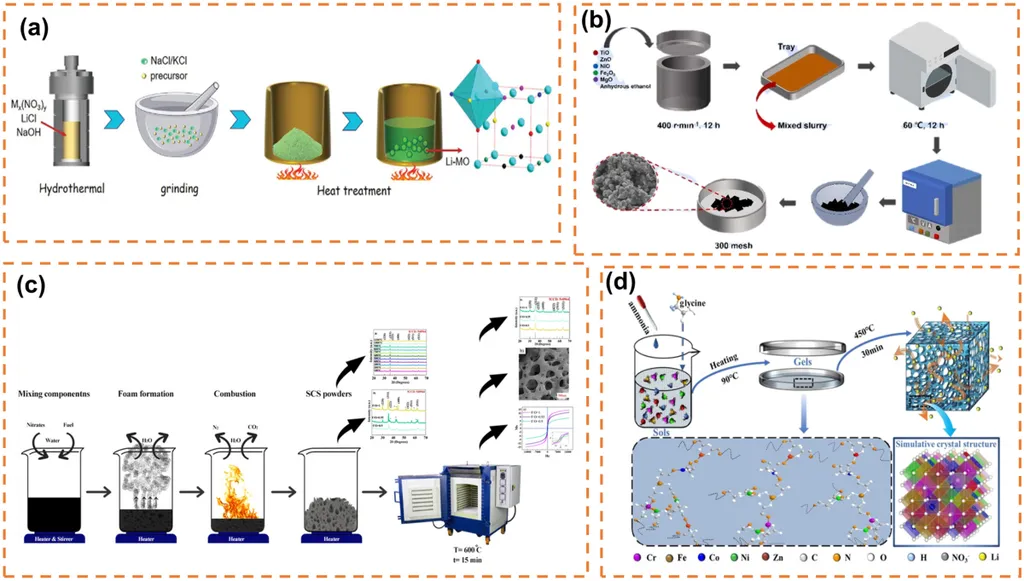
In the quest for more efficient and stable energy conversion technologies, researchers have turned to a novel strategy that might just revolutionize the way we think about air electrodes in reversible solid oxide cells (R-SOCs). A recent study led by Yuhe Liao from the School of Environment and Energy at South China University of Technology has introduced a high-entropy air electrode that could significantly enhance the performance and stability of R-SOCs, potentially opening new avenues for the energy sector.
The study, published in *Materials Reports: Energy* (translated from Chinese as “Materials Reports: Energy”), focuses on addressing the long-standing issues of insufficient stability and poor surface reaction kinetics in air electrodes. These challenges have been major roadblocks in the development of R-SOCs, which are crucial for both fuel cell and electrolysis applications. Liao and his team have developed a high-entropy air electrode, (La0.12Pr0.12Nd0.12Sm0.12Gd0.12)Sr0.4Co0.2Fe0.8O3−δ, or LPNSGSrCF for short, which demonstrates remarkable improvements over traditional materials.
“Our high-entropy air electrode shows a significantly lower polarization resistance and better durability compared to conventional electrodes,” Liao explained. The LPNSGSrCF electrode achieved a polarization resistance of 0.15 Ω cm2 and a durability rate of 1.3 × 10⁻³ Ω cm2 h−1 at 650 °C, outperforming the traditional La0.6Sr0.4Co0.2Fe0.8O3−δ electrode, which had a polarization resistance of 0.31 Ω cm2 and a durability rate of 2.0 × 10⁻³ Ω cm2 h−1.
The enhanced performance of the LPNSGSrCF electrode is attributed to its high concentration of oxygen vacancies and rapid reaction kinetics. These properties were verified through a series of advanced analytical techniques, including X-ray photoelectron spectroscopy, electrochemical impedance spectroscopy, and distribution of relaxation times studies. The practical implications of this research are substantial. An R-SOC equipped with the LPNSGSrCF air electrode achieved a peak power density of 1.05 W cm−2 in fuel cell mode and a current density of −0.89 A cm−2 at 1.3 V in electrolysis cell mode at 700 °C. Moreover, the cells with the LPNSGSrCF electrode could be stably operated in both modes for over 100 hours.
The commercial impacts of this research are far-reaching. R-SOCs are pivotal for energy conversion and storage, and improving their efficiency and stability can lead to more reliable and cost-effective energy solutions. “This breakthrough could pave the way for more efficient energy conversion technologies, benefiting industries that rely on clean and sustainable energy sources,” Liao noted.
The study’s findings not only highlight the potential of high-entropy materials in enhancing the performance of air electrodes but also underscore the importance of continued research in this field. As the energy sector strives for more sustainable and efficient solutions, innovations like the LPNSGSrCF air electrode could play a crucial role in shaping the future of energy technology.
With the publication of this research in *Materials Reports: Energy*, the scientific community now has a new benchmark for air electrode performance, setting the stage for further advancements in the field of reversible solid oxide cells. The implications for the energy sector are profound, offering a glimpse into a future where energy conversion technologies are more efficient, stable, and environmentally friendly.